Killer’s Aggravation – Homoeopathic Medicines Can Kill You
Killer’s Aggravation and Homoeopathic Medicines
Now a days we frequently see people buying homoeopathic medicines over the counter without doctors prescription, consodering it to be safe and can be consumed by anyone. Its surprising to see that even parent are buying these medicines for their new born kids.
Most of these medicines are patented mix of multiple medicines which is against homoeopathic principles, as homoeopathic medicines are meant to be taken only one medicine at a time.
Also they are proved by using very low standards of drug provings that too completely contradicting principles of homoeopathy as homoeopathy strictly doesnt allow use of multiple medicine at a time.
If it is single medicine one is consuming it doesnt allow frequent repetition of dose in same potency with exceptions, its a very highly skilled to decide at which potency and how many repetition does a patient require as it varies from person to person in similar conditions, most of the times only one dose is administered to cure the conditions, more of it only complicates the case most of the time.
One should be aware that homoeopathic medicines are effective only if they match the constitution and symptoms of the patient or else it may not act at all and the disease may keep on progressing making it worse on the other hand if the medicinines that are not selected by process for repertorisation for indivudualisation ans similimum dosing and if taken too frequently unhomoeopathically then it produces a new artificial morbid condition in the body which can be so severe so as to cause gross pathological change in the body which may be irreversible damaging the body permenantly.
Its a myth that HOMOEOPATHIC MEDICINES does not have side effects!
The fact is , Its HOMOEOPATHY that does not have side effects! But HOMOEOPATHIC MEDICINES if not taken in accordance with HOMOEOPATHIC PRINCIPLES as mentioned in HOMOEOPATHIC ORGANONof medicine then the recipient may have severe aggravations.
As mentioned in KENT’s 12 observations the very first point says “Prolonged aggravation with final decline of patient” also termed as KILLER’s Aggravation by practitioners , a FATAL CONDITIONwhich we not too frequently encounter and is difficult to handle.
So be careful before self medicating or giving medicines to your kids, always consult a registered homoeopathic consultant first.
ANKYLOSING SPONDYLITIS (AS) / MARIE’s Disease / BEKTEREV’s Disease is a Chronic Autoimmune or Autoinflamatory systemic disease which predominantly affects joints and bones of Spine and Pelvis
It falls under AXIAL SPONDYLOARTHRITIS Category.
CAUSES OF ANKYLOSING SPONDYLITIS
Causes are obscure, though Genetics Environmental Factors and Lifestyle in combination are believed to be involved in causation of Ankylosing Spondylitis (AS)
It falls under Sero-negative Systemic Rheumatic disease where its believed to be mediated by Autoimmune or Autoinflamatory response.
Human Leucocyte Antigen HLA B27 subtypes B2701and B2759are class I antigen encoded by B locus of Major Histocompatibility Complex (MHC) on Chromosome 6 and presents antigenic peptides (derived from self and non self antigens ) to T cells. HLA B27 is strongly associated with Ankylosing Spondylitis as 90% of patient showing symptoms of Ankylosing Spondylitis has a genotype presenting it. and 2% of all having genotype expressing HLA B27 contracts Ankylosing Spondylosis.
PATHOGENESIS OF ANKYLOSING SPONDYLITIS
Pathogenesis of AS is still not clear and many factors associated with the pathophysiology directly or indirectly have been identified
Human Leucocyte Antigen (HLA B27 subtypes B2701and B2759) are class I antigen encoded by B locus of Major Histocompatibility Complex (MHC) on Chromosome 6 and presents antigenic peptides (derived from self and non self antigens ) to T cells. HLA B27 is strongly associated with Ankylosing Spondylitis as 90% of patient showing symptoms of Ankylosing Spondylitis has a genotype presenting it. and 2% of all having genotype expressing HLA B27 contracts Ankylosing Spondylosis.Now this association with HLA B27 suggests possible link with CD8 T cells though not proven to involve self antigen it might also be due to reactive arthritis following infection and the antigen might be derived from intracellular microorganism; HLA B27 has many unusual varied properties also it has ability to interact with CD4 so possible association of CD4 in AS is also a probability.
Tumour Necrosis Factor α (TNF α) is found to b implicated in Ankylosing Spondylitis
Interleukine 1 (IL 1) is also associated in pathogenesis of Ankylosing Spondylitis
Anti-Neutrophil Cytoplasmic Antibodies (ANCAs) are associated with Ankylosing Spondylitis but is not indicator of severity of disease
Autoantibodies Specific to Ankylosing Spondylitis have not been identified
PTGER4 gene codes for prostaglandin EP4 receptor(EP4). which is associated with bone remodeling and deposition and is highly expressed in those sites of vertebral coloumn which are involved in Ankylosing Spondylitis . Single Neucleotide Polymorphism (SNP) of A/G variant rs10440635a close to the PTGER4 gene on human chromosome 5 possibly influences excessive production of EP4 which causes excessive bone remodelling and deposition in Ankylosing Spondylosis; though this type of SNP and its association with increased rate of Ankylosing Spondylosis is found only in few ethnic groups
All these and other unknown factors contribute in pathogenesis of Ankylosing Spondylitis which typically results in Annulus Fibrosus Disci Intervertebralis (fibrous ring) of intervertebral disc to OSSIFY which results in the formation of marginal SYNDESMOPHYTES between adjoining vertebrae giving rise to BAMBOO SPINEtype appearance of spine
SYMPTOMS AND DIAGNOSIS OF ANKYLOSING SPONDYLITIS
Genetic Testing For Ankylosing Spondylitis
HLA B27 is a non specific test For Ankylosing Spondylitis
As although 90% of those who have AS are HLA B27positive(50% in african-americans and 80% in mediterrenean)
But it has seen in many ethnic group ;esp north scandivanian;that Only 2 % of total HLA B27 positive have AS
Blood Test for Ankylosing Spondylitis
There are no specific Blood Tests Available for AS except for general inflamatory indicators like ESR and CRPwhich are elevated and tend to increase further on acute episode
Radiological Investigation For Ankylosing Spondylitis
There are no specific Blood Tests Available for AS So its diagnosed based on typical radiological changes but it takes 8-10 years for the disease to become evident enough to establish diagnosis neither CT or MRI can evaluate the disease in early stages
Typical radiological features are:-
Axial Spondyloarthritis
Early Xray changes include erosion and sclerosis of sacroilliac joints
in later stage that erosion increases resulting in pseudo-widening of joint space and Bony Ankylosis
squaring of vertebrae with spine ossification with fibrous band running longitudinally called syndesmophyte giving a bamboo spine appearance
Now in case where there are no evident radiological signs it becomes difficult to establish diagnosis as there are no specific blood tests for AS. In such cases clinical features signs symptoms and other non specific blood tests are conducted to evaluate the probability of AS; they are :
Chronic backache with insidious onset before age of 40yrs which has peculiar modalities- Aggravates on rest ;at night and Ameliorates on moderate movement ;exercise ; after getting up from bed in morning
History of inflamatory arthritis or tendinitis
Family history of axial Spondylosis
Positive HLA B27
Responds well to NSAIDs
Elevated ESR and CRP
Other accompaning conditions like IBS Uveitis psoriasis
Schober’s test is a clinical performed during physical exam which is measure of flexion of lumbar spine.
BATH ANKYLOSING SPONDYLITIS DISEASE ACTIVITY INDEX
BASDAIindex score is an index which is based on multiple clinical radiological genetic and blood parameters which helps in establishing stage and diagnosis and determine type of management and treatment required
BATH ANKYLOSING SPONDYLITIS FUNCTIONAL INDEX
BASFIindex to acess functional impairment
GAIT
HUNCHED POSTURE is a severe complication of AS resulting due to complete spinal fusion leading to increased spinal KYPHOSIS which results into forwar and downward shift of Center of Mass to compensate it the knee flexes and ankle dorsiflexes.Their gait has a cautious pattern as they have reduced shock absorbing ability and cant see horizon.
INDICATED HOMEOPATHIC MEDICINES FOR ANKYLOSING SPONDYLITIS
RHUS TOX
Rhus tox is the most common homoeopathic medicine which is very valuable in case of Ankylosing spondylitis, and is useful in various kinds of pains. Rhus tox affects the multiple systems of the body indcluding spine, joints, extremities, skin and mucus membrrane. Patient usually presents with stiffness of back associated with restlessness, is the key indication of this remedy. Pains are aggravated after a period of inactivity. There is marked stiffness, lameness, and pain in the lumbosacral area of back and hips to thighs. Rheumatic pains spread over a large surface area at the nape of neck, back, loins extremities. The small of back aches while sitting. Painfull stiffness on rising from seat. We are led to think of this remedy where we find an irresistible desire to move or change the position constantly. After
resting for a while, when he wakes up and takes a first move, a painful stiffness is felt.
CIMICIFUGA RACEMOSA
Cimicifuga racemosa is one of the indicated remedy for ankylosing spondylitis where there is marked stiffness in the neck area. The patient usually presents with excessive stiffness in the neck with severe pain. The neck muscles feel retracted, neck stiffness is worsened by cold air. The muscular and crampy pains are primilarily are of neurotic origin, occuring nearly in every part of the body. Pains of Cimicifuga are like that of electric shock, which come and go suddenly. Violent lightening type of pain in posterior spinal sclerosis, stiff neck from cold air. Sensitiveness of spine especially in cervical and upper dorsal region. Severe aching pain in lumbar and sacral region.
KALMIA LATIFOLIA
Kalmia is a great rheumatic remedy. Dr Hering introduced Kalmia into homeopathic practice, he himself and his friends being the first provers. Kalmia is one of tbe efficient remedy in ankylosing spondylosis cases where pain and stiffness are marked in lower back,lumbosacral region and neck area. The pains are accompanied with heat and burning in affected area. Pain is attended with excessive stiffness in neck. The pain from neck often radiates down the arms or scapula. Violent pains in the upper dorsal vertebrae. Constant pain in spine. Sensation as if spinal column would break with an anterior convexity and feeling of paralysis in saccrum.
GUAIACUM
Guaiacum is one of the Hahnemans antisporics, is one of the beat known remedies in rheumatism, gout, ankylosing spondylitis. There is Pressure on the vertebrae of the neck. Stiffness in the back, extending from neck to small of back and saccrum, intolearable on slightest motion. Indicated when there are contractive pains between the scapulae. Stiffness from neck may extend to shoulder blades and its painful. All pains are aggravated from motion and heat and relieved during rest.
KALI CARBONICUM
Kali carbonicum is very useful in deep seated diseases lime Ankylosing spondylosis. Kali carb patient presents with severe back pain with stiffness. Small of back feels weak. There is marked Stiffeness and paralytic feeling in the back. Marked indication of kali carb is severe backache during pregnancy and after miscarriage. Burning in the spine. Lumbago with sudden, sharp pains extending up and down of back to thighs. Weakness caused by all potassium salts is more pronounced in this typical salt of potassium
group. Sharp stitching, stabbing pain felt in various parts of the body. Severe backache must lie down for relief.
AESCULUS HIPPOCASTANUM
Aesculus is one of the indicated remedy in ankylosing spondylitis. The main feature of Aesculus is matked pain in lumbosacral area of the back and hips with extreme stiffness. Pain from back radiates to thighs. Lameness in neck. Aching pain between the ahoulder blades, region of spine feels weak. Backache affecting saccrum and hips worse walking or stooping. When walking feet turn under. Rising from seat seems difficult, has to make repeated efforts. Severe pain in lumbosacral region making movement impossible.
SILICEA
Silicea is a very valuable remedy in case of spondylitis. The action of silicea is slow. In the proving it takes long time to develop symptoms. It is therefore suited to complaints which develop slowly. Presents with ankylosing spondylitis with stiffness in nape of neck with severe headache. Coccyx painful as after a long carriage ride. Weakness and paralytic stiffness in back, loins and nape of neck. Swelling and distortion of spine.Aching, shooting, burning and throbbing pain in lumbosacral region with contussive pain between shoulder blades.
COLOCYNTH
Colocynth has a long lasting action on the spine and nerves. The main feature of colocynth is severe pain in the back which finally settes down on the upper part of thigh and buttock. Pain usually confines to small spot making the patient limp and finally becomes so severe that he can neither stand nor walk. Severe burning pain along the saccrum, cramps in hip. Feels better by doubling up, hard pressure and warmth.
CONIUM MACULATUM
Conium maculatum is deep acting antisporic remedy, its action disturbs almost all the tissues of the body. Very well indicated in ankylosing spondylitis of back, weakness is the most striking feature with dorsal pains. Effects of bruises and shocks to spine. After injuries especially in lumbar region. Severe rheumatic pains. The pains are relievex by putting feet on chair. Pain between the shoulder blades. Dull aching pain in lumbar and sacral region.
CALCAREA PHOSPHORICUM
Calcarea phos is a great tissue remedy, though it resembles calcarea carb in many aspects but has its own characteristic symptoms. The spher of phosphate of lime includes all bone diseases whether due to some inherited dyscrasia or defective nutrition in osseous and other structures. It is.a bone salt.without this element no bone is formed, hence it is a valuable remedy. Patient usually presents with weakness of spine, there is curvature of spine towards left , lumbar vertebrae bent towards left. Soreness in sacro iliac symphysis. Rheumatic pains from draught of air with stiffness of neck and back.
Arthritis is a term derived from “ARTHRON” means Joint and “ITIS” means Inflamation
Inflamation of joint and surrounding tissue is called ARTHRITIS
Its a general term used to describe pain swelling of joint and its surrounding tissue.
When one joint is involved its called Monoarthritis and when more than one joints are involved its called Polyarthritis
Different types of arthritis have different causative factors like
Mechanical
Immunological
Metabolical
Spetic
Genetics
Lifestyle and Evironmental factors
Though each factor has contribution in certain degree in every type of arthritis; Still it can broadly be classified into 4 major category based on the predominant factor responsible for their Pathophysiolohy/Pathogenesis :
Mechanically mediated type
Immunological mediated type
Metabolical mediated type
Spetic
With Genetics Lifestyle and Environment as Contributory factors in each type.
Further various major subtypes are described in detail in following link:
HOMOEOPATHIC MEDICINES and MANAGEMENT OF ARTHRITIS
Homoeopathic Arthritis Management depends on individualisation of the patient based on present symptoms, past history, family history and constitution of the patient.
In arthritis cases it is necessary to take into account the following points (with constant search for underlying miasm and constitution type):
When it started, that is since how long its been there.
How was the onset when it appeared first time.
Wether the complaints had incidious progression or it was sudden.
Which joint is involved, wether its single joint or multiple, wether its bilateral and symetrical or diagonal.
Particulars like which part was affected first, which side it started first and how much time it took for progression to other side or other joints, sequence in which joints were involved.
How and when it gets triggered, aggravation pattern morning stiffness , aggravation on rest/ motion, relation to climate winter/monsoon/summer, relation to heat and cold, aggravation to any particular type of food.
Wether its constant or intermittant.
The joint is warmer than rest of the body or not.
Wether there is swelling around the joint or not.
Nodes or nodosities on or around any joints. or any other signs of disfigurement.
Movement or other disability in joint.
Patient has fever or not or h/o fever before or during the episode of joint pain started.
Presence of any concomittants or accompanying symptoms and wether those symptoms are of Psychotic, Syphilitic or Psoric nature.
Wether he has any other systemic complaint especially any other autoimmune or metabolic disorder.
History of injury, surgery especially affecting neurons or musculoskeletal structure.
Nature of work the patient does , postural habits, structural anomalies disfigurements.
Diet sleep and exercise routine water intake should also be noted carefully.
It is important to note family history of patient wether first degree relative had any autoimmune or metabolic disorder.
Wether patient was or is under any long term medication.
A careful history of all communicable ailments should be recorded in sequence as they had been contracted by patient, as it helps us evaluate when and how was the vital force deranged in past and wether the present condition is manifestation of some past ailment, that is any deep seated miasm, also it helps to establish wether its some inherited genetic condition or its acquired condition also it helps differentiate between
Vector borne conditions like post viral arthralgia/arthritis and Group A streptococcal borne post pharyngitis systemic autoimmune condition AND
Other Systemic autoimmune conditions like Rheumatoid Arthritis SLE psoriatic arthritis.
These basic question will lead you towards a broader vision in the case and will let you reach upto some conclusion that under what category of arthritis it should be classified and will lead you towards some understanding of miasm and constitution.
As I have mentioned in my other arthritis articles that basically I divide all types of arthritis into four major categories based on their pathogenesis.
Mechanical
Immunological
Metabolic
Septic
After being diagnosed and classified the disease condition from one of the above group we can go further on how to manage each type of case.
Immunologically mediated
Once established that its an immune mediated arthritis its necessary to rule out any damage to other organs like heart, liver, kidney, pancreas, eyes etc, as in most cases autoimmune arthritis is found to involve other system and organs or it is a part of broader systemic autoimmune condition and it is all the more necessary to find out miasmatic background, constitution and individualising symptoms, as such types of arthritis are deep seated having its own sets of aggravating and ammeliorating factors, furthermore its also observed that mental stress and emotional fluctuations have much impact on intensity and frequency of aggravations in almost all types of immunologically mediated arthritis, so its of utmost importance to take proper account of patient’s mental emotional past and present including likes and dislikes aversion and cravings, which helps us to individualise the case.
Once the we have derived constitution , miasmatic background and individuslised the case then comes medicine selection process,
I strongly recomend to go by constitution of patient in immunologically mediated arthritis rather than going theraputic remedy selection.
and it should be kept in mind that the selection procedure of medicine should correspond to degree of mental PQRS , degree of systemic PQRS and degree of musculo-skelatal symptoms of the person in disease should match the degree of pathogenic action on various sphere of the specific medicine.
Though during acute exacerbations of disease it becomes necessary many a times to administer short acting acute medicines theraputically where the new symptoms desnt fall into sphere of the constitutional medicine thats been administered.
Many a times only a single dose of similimum medicine selected may suffice to cure the case but all patients are not the same each has a different constitution and miasmatic background and severity of ailment and other external inimical factors, so in many cases it may take series of medicines one by one as per case demands during progression of treatment before the case is cured. It all depends upon how well the physician is able to find out the similimum and type of case and its requirement.
Mechanical
Under mechanical type of arthritis falls osteoarthritis and other types of arthritis caused due to mechanical injuries in such types the case is usually tale tale and shows basic picture of mechanical wear n tear which might be due to poor constitution inherited or might be acquired later on due to external inimical reasons.
In such cases it is necessary to consider that basically the constitution is lacking the capability to repair regenerate and maintain proper quality of joint cartilage and underlying bone and has tendency towards chronic sub-acute inflamation. in such cases it is important to take complete history of patient and family with details of gestational period and individulisation based on Peculiars should be derived forindividualised remedy selection for complete annihilation of condition; if not done so the patient might find relief for time being but the symptoms might keep relapsing with time again and again.
In many cases the repair and regeneration mechanisms are sufficient but mechanical wear and tear are in greater proportion and on regular basis so damage tends to accumulate, in such cases there is not much need to go deep into deriving constitution and treatment approach should aim towards elimination of maintaining cause that is excessive mechanical wear and tear and suppliment with nutritious diet and rest to affected part and symptomatic homoeopathic medicines based on theraputics will also work well.
Metabolic
Again this type of arthritis is a deep seated genetic in nature and they might accompany other metabolic syndromes and requires a careful case taking to get a broader picture of the person in disease, all aother systems and organs should be evaluated to understand sphere of disease pathology its extent and severity so it helps us to select the most similimum homoeopathic remedy.
The approach in such cases again remains constitutional , miasmatic and remedy should be selected only after proper individualisation of case and repertorisation.
Septic
In septic arthritis pt needs to be administered short acting acute remedies theraputically with support of deep acting constitutional remedy which can be administered intermittently or after the acute symptoms are ammeliorated to rearrange the deranged vital force.
Commonly Used Homoeopathic Medicines for Arthritis and its symptoms and indications:
RHUS TOXICODENDRON Usefull in almost all types of joint and musculoskeletal complaints where the symptom call for the medicine like stiffness of joints aggravatedon rest and ammeleorated on motion in any ailment involving musculoskeletal system, rheumatic joint affections, sprain and injury on joints etc
ARNICA MONTANA blunt injury and trauma, sore lame bruised sensation with swelling concussion and contusion call for this remedy
ACTEA SPICATA Pain stiffness and swelling of small joints especially of hands , good remedy for post viral arthralgia like in chickengyunya where small joints are involved
BRYONIA ALBA Stiffness and pain with hot swelling, redness of joints with stitching and tearing pain aggravation on least motion every spot is painful on slightest pressure
LEDUM PALUSTURE Gouty arthritis involving small joints of extremities, hot swollen joints with throbbing pain, gouty nodosities, pain in ball of great toe, podagra, swollen ankles and painful soles, aggravation on warmth of bed , rheumatism starting from lower extremities and ascending upwards. right side more involved compared to left.
HYPERICUM PERFOLIATUM Degenerative changes of joints involving nerves, sciatica, coccygodynia, cervical and lumbarspondylosis with nerve compression, tingling burning and numb sensation with lancinating pain calls for the remedy, darting pain of shoulders , cramps in calf muscles, pain in tips of toes and fingers, sensation of pressure along the ulnar side if arm.
PLANTAGO MAJOR helps relieve bony snd neuralgic pain in arthritis
BELLIS PERENIS Soreness lameness of joints and muscles, rheumatic joint affections, sciatica where pain radiates down the anterior portion of thigh, sensation as if elastic band is tied around wrist feeling of contration of wrist joint, Railway spine, sprain and bruises of joints and muscles, good remedy where varicose veins complicate case of arthritis or both are coexisting in any patient.
ACTEA RACEMOSA Rheumatism affecting intercostal region back and neck, cervical spondylosis caising nerve compression and electric shock like shooting pain comes suddenly reaches peak and goes suddenly, stiffness and pain in tendo-achilles. sensation of heaviness in lower extremities, heavy aching tensive pain with twitching and jerking of limbs.
APIS MELIFICA swelling of joint with synovitis and synovial effusion, spetic arthritis, red hot swollen joint , pain on sloghtest pressure or motion, gout , rheumatoid arthritis , post viral arthritis and arthralgia
CALCAREA CARBONICA osteoarthritis, degenarative changes in any joint , osteomalacia or osteoporosis causing joint degeneration, open sutures and fontanale in children, rickets , kyphosis and other loss of normal curvatures of spine, pigeon chest, fractures injuries of bones and joints
COLCHICUM Gouty arthritis , increased Serum Uric acid and tophus formation in joints. typical pain in great toe aggravated at night, sudden gripping cutting pain with much burning comes at night waking patient up from sleep
CALCAREA PHOSPHORICA osteoarthritis due to calcium deficiency , musculoskeletal complaints of old age, developmental musculoskeletal anomaly of growing children, fractures injuries of bones and joints.
BELLADONNA red hot inflamed joint with much pain and swelling
ACONITUM NAPELLUS Acute onset of pain and swelling , can be used in first 24hours or first stage of any acute inflamatory condition with severe mental restlessness fear fright and anxiety.
CALCAREA FLOURICA
NATRUM SULPH a very good remedy for gouty diathesis.
Caused due to mechanical stress and covert low grade inflamatory process.
Due to excessive mechanical stress there is increased in demand from factors responsible for repair mechanism. Initially this repair mechanism repairs as it normally should but then it becomes insufficient to repair with same mechanism so it starts compensatory mechanism where in, it tries to maintain structural aspect but at cost of quality of structural components which again due to its inferior quality gets damaged soon further due to prolonged regular mechanical stress these damages gets accumulated even further and now even compensatory mechanism fails to keep up with the amount of damage that’s been done , this starts erosion of the cartilage and the underlying bone and there is general degeneration of joint.
WHAT ARE THE RISK AND CAUSATIVE FACTORS FACTORS OF OSTEOARTHRITIS?
Mechanical injury like trauma causing damage to joint or any of its component useful in maintaining strenght structure gait and support to joint.
Mechanical stress due to different length of either legs
Mechanical stress due to neurological muscular disorder of muscles supporting that particular joint
Those who never had habit of running or jogging during their childhood or young age if suddenly starts running in excess on later age, or running along with an injury cuases severe mechanical wear and tear injury to joint.
Abnormal body gait and habitual abnormal postures
Genetics and hereditary
Hormone levels especially sex hormones
Metabolic syndrome and obesity( debated as its not the weight thats causing mechanical damage but rather its fats thats responsible to cause metabolic disorder contributing to osteorthritis)
Diet and Lifestyle
Prolonged regular mechanical stress and insufficient self repair causing accumulation of damages and later resulting into prolonged inflamation causes osteoarthritis.
Prevailing condition in body like Osteoporosis, metabolic disorders, autoimmune diseases, joint infections, congenital joint anomaly, certain syndromes like marfan syndrome, elher danlos syndrome, inflamatory diseases like lyme’s disease perthe’s disease
PATHOGENESIS OF OSTEOARTHRITIS
Chondrocytes are responsible to maintain elastic and tensile strength of cartilage by producing collagen and extracellular matrix which maintains hydration by compressive force driving water out and hydrostatic and osmotic pressure drawing water in.
Constant damage to cartilage puts extra load on chondrocytes ;if they aren’t able to repair the damage by producing sufficient collagen and extracellular matrix ; then they start producing different type of collagen just to maintain the structure as far as possible but then this collagen has a different character of retaining more water then the former which spoils the elastic and tensile strength of cartilage as a whole. This further damages the cartilage to the point where it starts disintegrating and shedding off in synovial space which puts extra load on synovium to clear it off for which synoviocytes triggers inflamatory response and synovitis and general mild inflamatory process in joint which gets prolonged due to constant mehanical stress and accumulated damages and finally inflamatory products accumulates damaging joint even further eroding cartillage and bone causing fibrillations and also reduced bone mineral density at site is observed (causation is in debate); finally there is general degeneration of joint leading to pain inflamation and loss of regular function of the affected joint.
WHAT ARE SYMPTOMS OF OSTEOARTHRITIS?
Low grade inflamation and degeneration causes pain due to which there may be loss of range of movement of a joint along its axis in varing degrees from mild to severe.
This loss of ability of movement further causes dysuse atrophy of muscles related to that particular joint and due to degenerative changes the joint becomes wider which gives typical lean muscle and wide joint looks, like in the Heberden’s Nodes and Bouchard’s Nodes in fingers
Osteoarthritis particularly involves weight bearing joint and joints more prone to mechanical stress like knee joint; lumbar spine cervical spine hip joint joints of fingers and less commonly other joints like ankle joint shoulder joint etc
It may present in one joint or in multiple joints at a time.
Exertion and motion aggravates the complaints and rest ameliorates the complaints.
Morning stiffness of affected joint is present in majority cases though not a specific symptom.
Aggravation in cold climate, high humidity, low atmospheric pressure is seen in many cases tough not consistent every-time.
Crepitation on movement or pressure are observed in affected joint.
Surrounding muscle spasms and when vertebral bodies are affected the spinal nerve corresponding to it may get compressed leading to spasms paraesthesia myalgia and cramps to correrponding musscle the affected nerve supplies.
Joint effusion, especially of knee joint are see not too infrequently.
DIAGNOSIS OF OSTEOARTHRITIS
In most cases sufficient clinical evidence supports the diagnosis but an X ray is required not only to reconfirm diagnosis but also to evaluate to amount of damage within as pain and other clinical symptoms are not indicator of the amount of damage within; in many cases we may also need to exclude other conditions for which further related investigations should be done.
HOMOEOPATHIC MANAGEMENT OF OSTEOARTHRITIS
Once its established that the patient is suffering from osteoarthritis the homoeopathic management of the case will be as follows
As per my classification criteria Osteoarthritis falls under Mechanically mediated type of arthritis
Under mechanical type of arthritis falls osteoarthritis and other types of arthritis caused due to mechanical injuries in such types the case is usually tale tale and shows basic picture of mechanical wear n tear which might be due to poor constitution inherited or might be acquired later on due to external inimical reasons.
In such cases it is necessary to consider that basically the constitution is lacking the capability to repair regenerate and maintain proper quality of joint cartilage and underlying bone and has tendency towards chronic sub-acute inflamation. in such cases it is important to take complete history of patient and family with details of gestational period and individulisation based on Peculiars should be derived forindividualised remedy selection for complete annihilation of condition; if not done so the patient might find relief for time being but the symptoms might keep relapsing with time again and again.
In many cases the repair and regeneration mechanisms are sufficient but mechanical wear and tear are in greater proportion and on regular basis so damage tends to accumulate, in such cases there is not much need to go deep into deriving constitution and treatment approach should aim towards elimination of maintaining cause that is excessive mechanical wear and tear and suppliment with nutritious diet and rest to affected part and symptomatic homoeopathic medicines based on theraputics will also work well.
Homoeopathic Medicines for Arthritis with its symptoms and indications:
RHUS TOXICODENDRONusfull in almost all types of joint and musculoskeletal complaints where the symptom call for the medicine like stiffness of joints aggravatedon rest and ammeleorated on motion in any ailment involving musculoskeletal system, rheumatic joint affections, sprain and injury on joints etc
ARNICA MONTANA blunt injury and trauma, sore lame bruised sensation with swelling concussion and contusion call for this remedy
ACTEA SPICATA pain stiffness and swelling of small joints especially of hands , good remedy for post viral arthralgia like in chickengyunya where small joints are involved
BRYONIA stiffness and pain with hot swelling, redness of joints with stitching and tearing pain aggravation on least motion every spot is painful on slightest pressure
LEDUM PALgouty arthritis involving small joints of extremities, hot swollen joints with throbbing pain, gouty nodosities, pain in ball of great toe, podagra, swollen ankles and painful soles, aggravation on warmth of bed , rheumatism starting from lower extremities and ascending upwards. right side more involved compared to left.
HYPERICUM PERFOLIATUM degenerative changes of joints involving nerves, sciatica, coccygodynia, cervical and lumbarspondylosis with nerve compression, tingling burning and numb sensation with lancinating pain calls for the remedy, darting pain of shoulders , cramps in calf muscles, pain in tips of toes and fingers, sensation of pressure along the ulnar side if arm.
PLANTAGO MAJOR helps relieve bony snd neuralgic pain in arthritis
BELLIS PERENIS soreness lameness of joints and muscles, rheumatic joint affections, sciatica where pain radiates down the anterior portion of thigh, sensation as if elastic band is tied around wrist feeling of contration of wrist joint, Railway spine, sprain and bruises of joints and muscles, good remedy where varicose veins complicate case of arthritis or both are coexisting in any patient.
ACTEA RACEMOSA Rheumatism affecting intercostal region back and neck, cervical spondylosis caising nerve compression and electric shock like shooting pain comes suddenly reaches peak and goes suddenly, stiffness and pain in tendo-achilles. sensation of heaviness in lower extremities, heavy aching tensive pain with twitching and jerking of limbs.
APIS MELIFICA swelling of joint with synovitis and synovial effusion, spetic arthritis, red hot swollen joint , pain on sloghtest pressure or motion, gout , rheumatoid arthritis , post viral arthritis and arthralgia
CALCAREA CARBONICA osteoarthritis, degenarative changes in any joint , osteomalacia or osteoporosis causing joint degeneration, open sutures and fontanale in children, rickets , kyphosis and other loss of normal curvatures of spine, pigeon chest, fractures injuries of bones and joints
CALCAREA PHOSPHORICA osteoarthritis due to calcium deficiency , musculoskeletal complaints of old age, developmental musculoskeletal anomaly of growing children, fractures injuries of bones and joints.
BELLADONNA red hot inflamed joint with much pain and swelling
ACONITUM NAPELLUSAcute onset of pain and swelling , can be used in first 24hours or first stage of any acute inflamatory condition with severe mental restlessness fear fright and anxiety.
For understanding of arthritis in general, its case-taking and homoeopathic management visit following link
Achlorhydria or hypochlorhydria is a condition where stomach and other digestive organs stops or has reduced secretion respectively of hydrochloric acid
CAUSES OF HYPOCHLORHYDRIA / ACHLORHYDRIA
It usually is secondary to a primary condition like bacterial overgrowth like helicobacter pylori etc which neutralizes HCl; Gastro-intestinal Metaplasia; Atrophic Gastristis; Reducing Basal Metabolic Rate (BMR); autoimmune conditions where there are autoantibodies formed against gastric parietal cells that produces Gastric Acid ; frequent long-term use of antacids like H2 receptor antagonist or Proton pump inhibitors; mucolipidosis type IV, procedures like Gastric Bypass Duodenal switch RNY; Islet Cells tumors like VIPomas ( Vasoactive intestinal peptides) and Somatostatinomas; Pellagra(niacin deficiency), Pernicious anemia, deficiency of mineral and electrolytes required to produce sufficient Gastric acid like sodium chloride potassium zinc iodine etc.
So its a vicious cycle where pre-existing condition causes achlorhydria and achlorhydria further aggravates that primary cause.
SIGNS AND SYMPTOMS OF ACHLORHYDRIA OR HPOCHLORHDRIA
So along with symptoms of primary disease it will also show Gastro-Oesophageal Reflux Disease, anorexia, Early satiety while eating , weight loss, abdominal discomfort , sensation of fullness and distention of abdomen, frequent diarrhea and constipation, iron deficiency anemia due to lack of HCl, pernicious nemia due to lack of Vit B12 and many other deficiencies like that of vitamin B complex, vitamin k, vitamin C and other micronutrients minerals like magnesium sodium chloride potassium zinc etc; causes many neuro-muscular disorders like general weakness esp. lower limbs with myalgia paraesthesia ataxia and gait disorders ;also psychological disorders like weak memory, mood disorders personality disorders, hallucinations etc. these patients are prone to infection of Vibrio Vulnificus and other usually uncommon infections of organisms found in food ( more commonly from seafood); all these complaints and many other collectively may prove fatal.
DIAGNOSIS OF ACHLORHYDRIA OR HYPOCHLORHDRIA
Oesophageal pH monitoring giving 24-hour profile of gastric acid Secretion
Gastric pH at endoscopy
Extreme low levels of pepsinogen A(PgA) < 17ug/l in blood serum and high serum Gastrin Level >500-1000pg/ml supports the diagnosis
Heidelberg test is an alternate test.
Many other tests like Serum iron, serum calcium, Vit B12, Vit D, Thaimin, CBC tests for various forms of anemia elevation in serum folate level s/o small bowel bacterial growth etc can help to exclude associated conditions.
Once achlorhydria is confirmed a hydrogen breath test should be conducted to exclude bacterial overgrowth.
Acne or Pimples is a chronic skin disorder affecting pilosebaceous units caused due to clogged skin’s hair follicles by dead skin, excess sebum, dust and pollution.
It is also called Acne Vulgaris
SYMPTOMATIC CHARACTERISTICS OF ACNE/PIMPLES
It is characterised by oily skin, comedons, black-heads, white-heads, pimples and scarring and pigmentation.
It usually presents itself in region dense with sebeceous glands, like on face, chest and back.
Strong Genetic and Heredity association is found in 80% cases. During puberty surge in hormones triggers Acne in both sexes. Diet, cleanliness, medication, infections, pollution environmental factors ,sunlight exposure, stress, smoking and other lifestyle factor seems to contribute in not all but many cases in varing degrees. propionibacterium acnes a commonly found on skin which frequently outgrows in number and contribute to acne in most of the cases.
CATEGORISATION METHODOLOGY TO JUDGE SEVERITY OF ACNE/PIMPLES
Acne are categorised based on severity and there are various methods to do this Cook’s photographic scale of 0-8 grades, Leed’s scale of 0-10 with 2 modified versions of 0-11 and 0-12 and Pillsburry’s scale of 1-4 grades. A scale of mild, moderate and severe is commonly used which easily helps to quickly decide line of treatment.
Mild form has only clogged hair follicle called comedones also known as black-head(open mouth comedone) and white-head(closed mouth comedone) and very occasional pimples are found on trunk .
Moderate form has pappules and pustules forming on clogged hair follicles called pimples are found on face and trunk.
Severe form has cysts and nodules its termed severe nodular acne and is present extensively on face and trunk.
PATHOGENESIS OF ACNE/PIMPLES
Acne is a chronic skin disorder affecting pilosebaceous units caused due to clogged skin’s hair follicles due to
Excess sebum production under influence of androgen
Excess keratin deposition in hair follicle
Infection and colonization of the hair follicle by Propionibacterium acnes
Local activation of inflamatory mediators.
Dihydroxytestosterone and increased amount DHEA-S of secreted during adrenarche leads to excessive Sebum production prevents dead cells and debri to clear itself from hairfollicle causing an initial keratin and debri clog within and form microcomedon, excessive skin cell proliferation also contributes in development of clog its further complicated by colonisation of Propionibacterium Acnes which forms a slimy biofilm within the hair folicle and helps forming a comedone.
If comedone is superficial the melanin pigments gets exposed giving it dark colour so its called blackhead also called open comedone.
If the comedone is deep within the hair follicle, unexposed, it is called whitehead also called closed comedone.
Many of the comedones further progress into papules, pustules and nodules, also it may affect deeper tissue and form deep tissue nodule.
HOMEOPATHIC TREATMENT WITH INDICATED HOMEOPATHIC MEDICINES FOR ACNE/PIMPLES
KALIUM BROMATICUM
Kali bromaticum is one of the most indicated remedy in case of Acne. In Kali bromaticum pimples usually begins in the teenage. Reddish pustules on the face causing grooves. Pimples usually have a depressed centre. Face is usually flushed, yellowish, cahetic look with pimples on face. In females the acne are worse prior to the menstrual period and during the time of menstruation. Exhausted look of face, lifeless and expressionless. Inflammation and great redness of face due to pimples.
JUGLANS REGIA
It was said that in the golden age, when men lived on acorns, God lived upon walnuts and hence the name Juglans (Jupitars nut). Juglans regia stimulates the body’s defense mechanism and acts on various skin problems like pimples, eczema etc. Juglans regia is a very beneficial remedy in case of Acne. Indicated comedone of face. Reddish hard painful swelling of cheeks due to pimples. Acne filled with pus. Sharply defined depressed dark red erruptions, pus is seen through the thin skin.
CALCAREA SULPHURICA
Calcarea sulph is a Schussler’s connected tissue salt and most of the indications for its use are derived from his clinical experience. It has been extensively used for acne treatment based upon the biochemic theory. Very valuable remedy in case of pimoles. pimples with pustules on the face. Pale and sick looking face. Severe erruptions on face with itching. Pain in the erruptions after exposure to cold. Cold sweat on face. Useful in severe cystic acne. Lesions usually persists in one place for weeks and do not heal quickly. Yellow creamy pus drains for a long time. Unhealthy skin with yellowish scabs. Pimples on face, near hairline.
MERCURIUS SOLUBILIS
Mercurius solubilis is a powerful remedy which acts on every organ and tissue of the body.Very useful remedy in cases of acne. Earthy, puffy, dirty looking face, with constantly perspiring skin. A big pimple is surrounded by multiple smaller ones. Itchy erruptions, yellowish brown or greenish discharge from pustular pimples, often streaked with blood. Worse from extremes of temperature. Yellowish scabs with purulent pustules. Severe Burning of pimples.
ECHINECEA ANGUSTIFOLIA
Acne is by far the most commonest skin condition. Although prevalent among teens, a number of old people are also struggling with this condition. Echinecea angustifolia is the most effective remedy in case of acne. Echinecea angustifolia plant has its roots from daisy family. It makes the subcutaneous and superficial blood vessel walls stronger. This makes the skin more resistant and less penetrable from either the bacteria or free radicles that promote the development of acne. Echinecia helps to lower the inflammation levels due to its antibacterial properties. Echinecea angustifolia enhances good circulation and hence the skin will be clear and free from dead skin cells that clog the pores. It helps to accelerate the body’s natural defense mechanisms of flushing out the toxins.
AZADERECHTA INDICA
Azaderechta indica has been used since decades as a traditional medicine in treatment of Acne. Azaderchta indica is known commonly as Neem. It is aaociated to Meliaceae family. Azaderchta indica detoxifies the body and acts as a blood purifier. Every part of Neem is useful with number of medicinal properties. It has been used since ancient times to treat many skin problems. It has a soothing effect on irritating skin. Very useful in acne. It acts as a nutritive tonic to skin. The antebacterial properties help to reduce the risk of infections. Azaderachta indica reudces the inflammations and puffiness of acne. Purifies blood thus gives radiance to skin. Pimples with severe redness, pus and tendency to form scars. Painful to touch.
BERBERIS AQUIFOLIUM
Berberis aquifolium has a marked action on the skin producing pimples, dry, rough and scaly erruptions. Acne is the most common and psychologically distressing skin disorder which is very well managed by Berberis aquifolia, it clears acne and hence clears the skin. It also helps to erase scars on skin. Berberis aquifolia is one of the recommended medicine for its cleansing effect and helps in lightening of complexion.
PULSATILLA NIGRICANS
Pulsatilla nigricans is a very effective remedy for acne during puberty. Especially indicated in young girls. Young girls usually suffer from various hormonal changes which lead to formation of pimples. Acne is worse during time of or around the time of menses, eating rich and fatty food. Especially indicated around time of puberty or when pimples breaks out near menstrual periods.
HEPAR SULPHUR
Hepar sulphur is one of the indicated remedies in acne. Usefull in acne in case of adolescents with unhealthy skin. Yellowish complexion. Great sensitiveness to slightest touch. Useful in pimples that are pustular in nature. The pus may be blood stained at times. The pimples are extremely painful. Tendency to form boils or abscess.
SILICEA
Acne like boils on face especially on cheeks. Slow healing acne which leave pitting scars. Silicea face is waxy, tired, anaemic. Pustular and vesicular erruptions spread over the face. Erruptions and crusts peel off with no healing. Useful in cases of pimples with offensive pus formation. Indicated in treating all types of skin problems. Pimples on forehead and cheeks. Silicea is usually chilly with increased sweating of palms and soles.
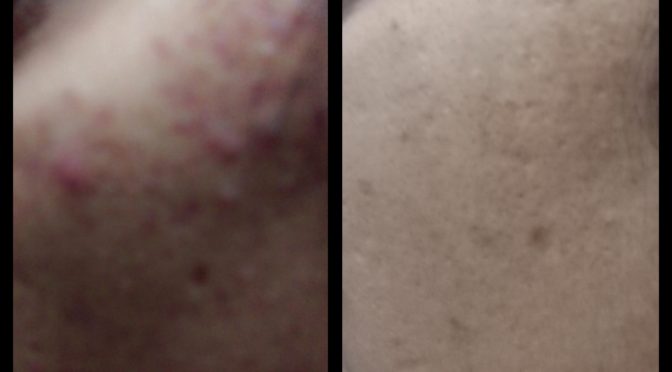
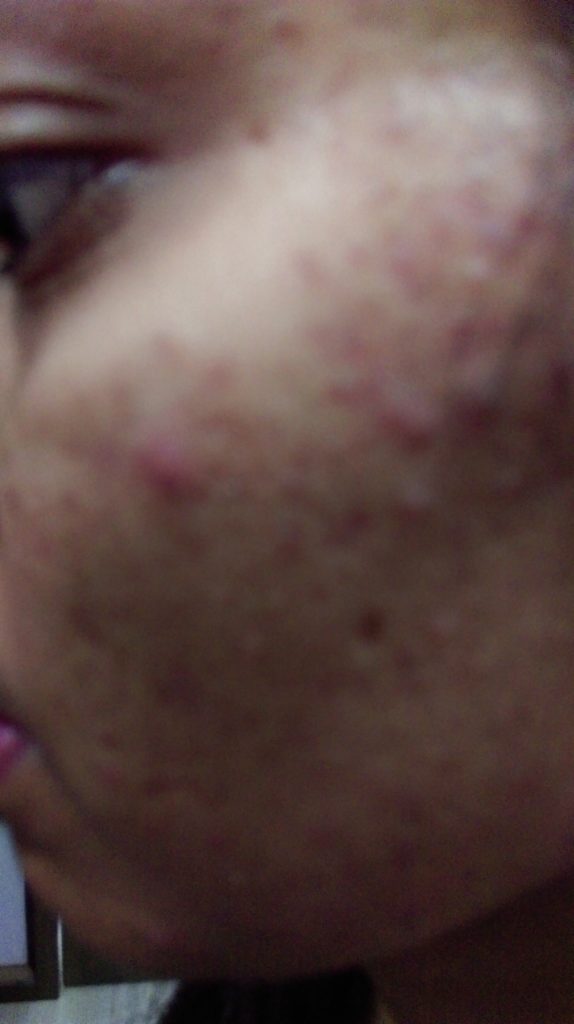
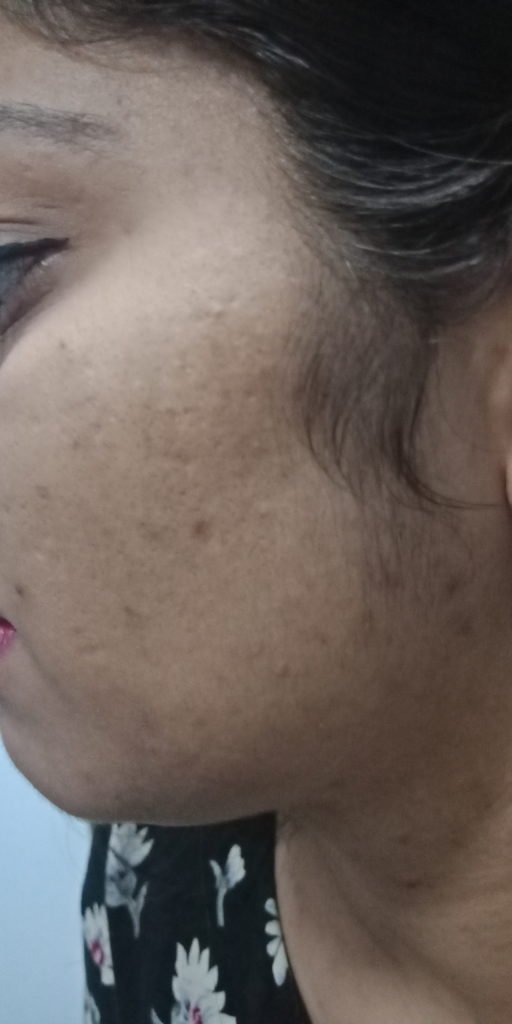
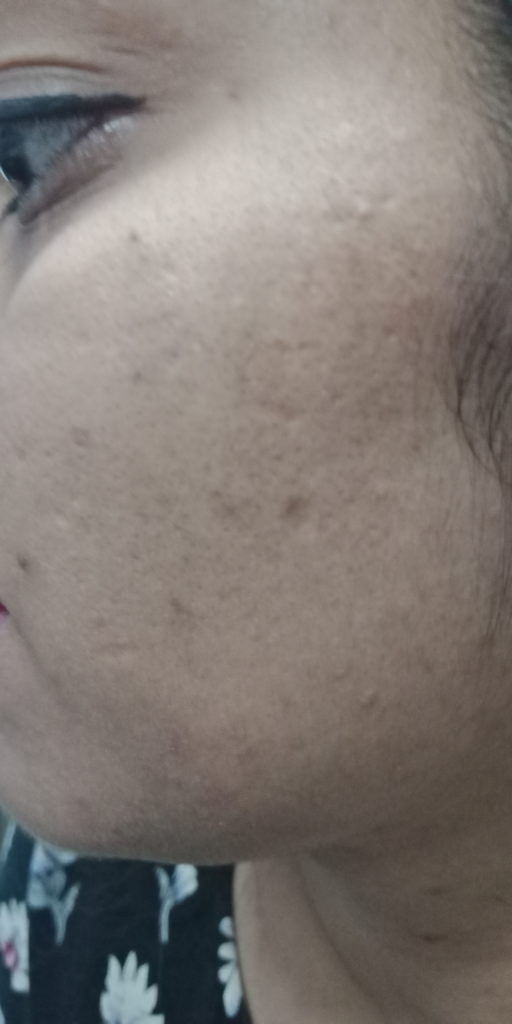
ACNE BEFORE HOMEOPATHIC TREATMENT AT Dr SHAH’s HOMOEOPATHYACNE CURED AFTER HOMEOPATHIC TREATMENT AT Dr SHAH’s HOMOEOPATHYCASE OF ACNE AFTER HOMEOPATHIC TREATMENT AT Dr SHAH’s HOMOEOPATHY
Nerve fibres originating from L4-S3 unites in front of piriformis muscle to form the widest single nerve in human body called the SCIATIC NERVE. Myalgia Paraesthesia in the corresponding region of supply of the Sciatic Nerve is termed as SCIATICA.
This symptom can be due to compression of /injury to /pathology of Sciatic Nerve or its nerve fibre origin.
Compression/Injury/ Pathology can be due to trauma / mechanical wear and tear / pathological changes around sciatic nerve or at origin of its fibres at lumbar and sacral region.
Patients presenting with pain along nerve path; should be tested for straight leg raise test
Further imaging tests CT, MRI, MRneurography helps to find out exact cause
Person should also be tested for any deficiency of Calcium through Bone Mineral Density ; Vitamin D levels where sciatica is due to bony degeneration or osteoarthritis of lumbar spine or osteoporosis in general.
In patients with sciatica due to spinal complaints originated from mechanical reasons
Secure lower back(lumbosacral region) and give it proper rest; mild exercises not involving lumbo-sacral region; helps by not involving lower back but still maintaining healthy equilibrium of body thus helping faster recovery.
Spinal manipulation helps to an extent in disc related pain which is contraindicated in progressive neurological deficits
Patients with sciatica due to non mechanical spinal reason / secondary to tumour / some other pathology like inflamation or abscess around; should be treated first for primary reason.
Homoeopathic Medicines for Sciatica with Indications
MAGNESIA PHOSPHORICA
Magnesium phosphoricum is a great antipsoric remedy. Mag phos is a constituent of nerves, muscles, bones, spine, brain, blood corpuscles. It helps to create white fibres of muscles amd nerves. The deficiency of this salt allows the fibres to contract causing spasms, cramps and other nervous phenomenon. Magnesium phosphoricum is thought of in all maladies having origin in nerve cells and in muscle tissue. Mag phos is very well indicated in Sciatica. It is suited to tall, dark, neurotic, exhausted people. Used for neuralgic pains, having spasmodic effects and have great influence on nerves and muscles. The pains are very violent and may affect any nerve. Pain localises itself in a nerve and become worse especially in case of sciatic nerve. Pains come in paroxysms. The patient feels better in warm place where neuralgias are better. There are times when a nerve in which there is a considerable pain becomes sensitive to pressure. Stiffnness, numbness along the route of nerve from prolong exertion. Rest relieves most of the complaints.
RHUS TOXICODENDRON
Rhus tox is a frequently indicated remedy in rheumatic affections, and neuralgias. Rhus tox affects the fibrous tissue markedly joints, tendons, sheaths, producing pain and stiffness. Rhus tox is very useful in Sciatica. Pains usually spread over a large surface area along the route of nerve, stiffeness of limbs with paralysis. Presents with tingling in feet. Affections of nerves and spinal cord give rise to paretic effects. Symptoms appear on the eft side and go from left to right. Patient is very restless., cannot rest in one position. Complaints come on from cold damp weather aspecially to cold. Pains that run through Rhus tox are aching, tearing with numbness and paralytic weakness of limbs with loss of sensation. Presents with low back ace with stiffnness, aggravatiom on resting after excercise.
CALCAREA CARBONICA
Calcarea carb is chief representative of calcium compound. Calcium metabolism is active during childhood and becomes defective in middle age. Calcarea patient can be described as fair, fat and flabby with tendency to gain weight. Calcarea carb has main action on the vegetative sphere with impaired nitrition being the keynote of its action. Calcarea carb has marked indication in case of sciatica, where there is severe pain in the lower back, lumbar spine to the buttock and down the back of leg. Excruciating pain with burning sensation. Presents with numbness tingling sensation in affected leg or foot. Associated with Weakness of extremities.
BELLIS PERENIS
Bellis is known commonly as Wound wort, therfore like Arnica it is great traumatic remedy. Very well indicated in Sciatica. There is results of injurie to nerves with intense soreness and intolerance of cold bathing. Severe pain at the lowet back, radiatinv downwards, pains may vary widely from a mild ache to sharp burning sensation, can feel like a jolt or electric shock. Worse when you cough sneeze or due to prolong sitting aggravates the complaints. Sore bruised feeling in the pelvic region.
HYPERICUM PERFORATUM
Hypericum perforatum is an excellent remedy for injury to parts rich in sentient nerves. Indicated in traumatic neuralgiaand neuritis.Spasms after injury.
Hypericum perforatum is considered when the sciatic pain is attended with tingling, burning and numbness in affected limb. The spine is very sensitive to touch. Walking or stooping is impossible from intense pain in back and lower limb. Aching pain in left sciatic nerve after prolonged sitting. Violent pains and inability to walk or stoop after a fall on coccyx. Excessive painfullness is the guiding symptom, associated with cramps in calves.
ARNICA MONTANA
Arnica montana is frequently indicated remedy in case of sciatica. Patient usually presents with excessive soreness of lower limbs. Severe neuralgias with low backache and pain radiating from back through thigh to foot. Numbness and soreness after over exertion. Cannot walk erect on account of bruised pain in pelvic region. Limbs ache as if beaten. Numbness in feet. Sore lame bruised feeling all over the body, bed feels hard. Slightest tough is unbearable. Arnica is usually suited to cases when an injury however remote seems to have caused the trouble. Extreme restlessnes, patient constantly changes his position.
CALCAREA PHOSPHORICA
The sphere of action of phospahte of lime includes all neuralgic affections and bone diseases whether due to some dyscrasia or defective nutrition. Calcarea phos is One of the most important tissue remedies. Very well indicated in case of sciatica. The back pains are worse from cold stormy weather. Severe pain in the back and along the route of sciatic nerve from straining, tearing, shooting, and aching in the spine. Soreness in the sacroiliac symphysis. Pain in the lumbar region and sacrum extending to the feet.
PLANTAGO MAJOR
Plantago usually affects the nerves causing nerves causing neuralgias. Patient usually presents with sharp cutting type of pain. Numbness in the affected parts. Trembling of limbs. Severe pain in the back extenxing to feet. Sharp shifting type of pains. Very useful remedy in case of sciatica.
COLOCYNTHS
Colocynth has a long lasting action on the nerve especially the scoatic nerve. The principle feature of colocynth is its severe tearing, neuralgic pains, pains are so severe that the patient is unable to remain still. The sciatic pains ae better feom hard pressure. Neuralgic pains are cutting, clamping, gnawing type followed by numbness and lumbar ache which is relieved by pressure. Severe pain in the back extending downwards, sensation as if heavy weight in the lumbo dorsal region lying on left side. Along with sciatica there is agonising pain in abdomen causing patient to bnd double with restlessness. Sciatic pains extend from lumbar region to limbs. Tensive lancination in lumbar region and hips especially while lying on the back. Pain while walking as if psoas muscles were too short, on stooping it caeses but commences again while walking. Usually Left sided sciatica, pain along the course of left sciatic nerve. Pain in low back radiates to toes.
GNAPHALLIUM
Gnaphalium is an indicated medicine in sciatica, when the pain in the sciatic nerve is attended with numbness. Useful in cases of sciatica where pain is confined to calves and feet. There is intense pain in the nerve accompanied by cramps alternating with numbness. Intense pain along the route of sciatic nerve. Lumbago with numbness of parts and weight or heaviness in pelvis.
ACONITUM NAPELLUS
The rapidity of action of aconite determines its symptomatology. Aconite is one of the indicated remedy in sciatica. Symptoms are acute, violent and painful. They appear suddenly and remain for a short while as if a big stormwhich soon blows over. Neuralgic pains are very intense. Pain in the back. Sensation of burning, numbness, tingling, crawling semsation alon the route of nerve. Parts remain sore and numb after pains. Physical and mental restlessness with state of fear, anguish.
BELLADONA
Belladona is very useful remedy in sciatica. Where the pains are sudden and violent with redness and heat of affected parts. Belladona acts on the nerve centres producing twitching, pains, jerks and spasms in limbs. Invluntary limping. Trembling of limbs. The lower part of the back feels as if broken. Sensation of heaviness in the buttocks and thigh. The sciatic pain is worse from heat and relieved from bending backwards and by rest. Symptoms of belladona that is pain and suffering come on suddenly pass a regular course amd subside suddenly.
SILICEA
Silicea is one the indicated remedy in sciatica. Presents with neurasthenic states and increased susceptibility to nervous stimuli. Sciatic pains usually start in thr back hips and run through the course of sciatic nerve through back of legs and feet. Severe cramps in calves and soles. Weak spine. Severe pain in coccyx.
BRYONIA ALBA
Bryonia is most effective medicine for sciatica that gets worse from walking. The slightest motion may worsen sciatica., in such cases lying down absolutely still provides some relief to the patient. Heaviness in the Affected hip or leg. The general character of pain here is stitching type of pain, pains greatly aggravated by slight motion and better by rest. Usually adapted to nervous dry, alender people. Pain in small of back which becomes worse by stooping. Scaitica better by lying on painful side.
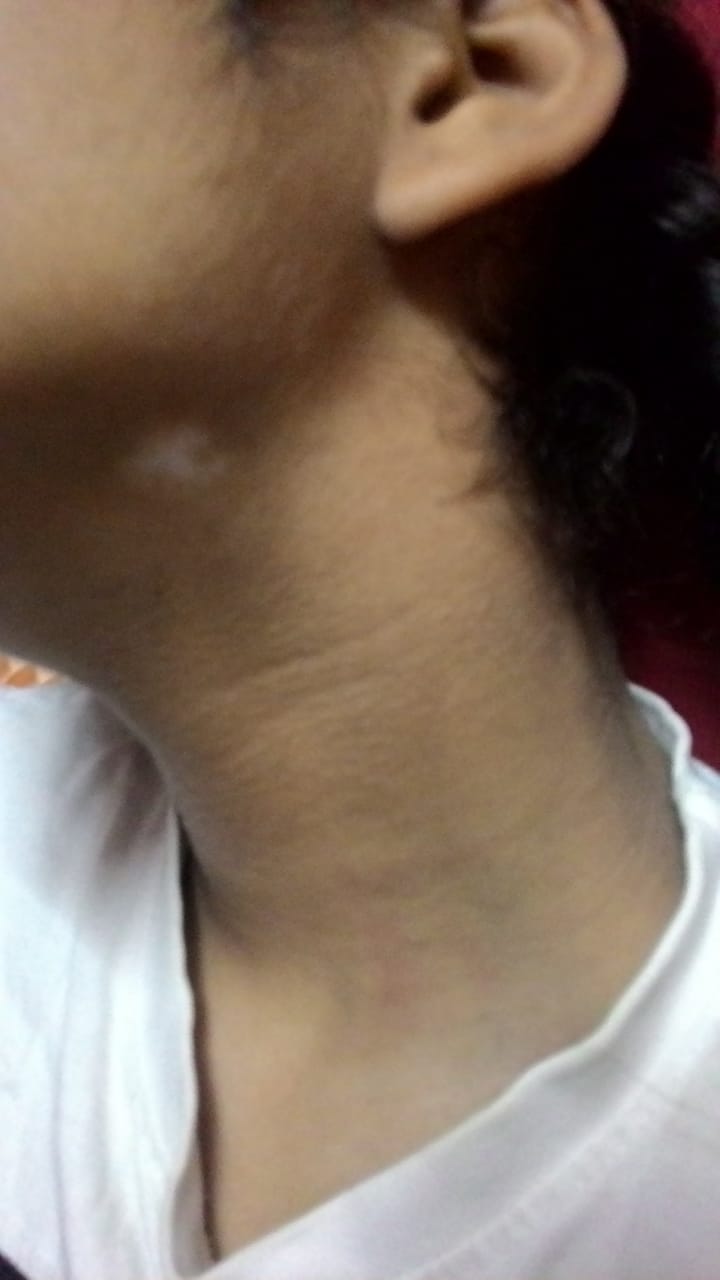
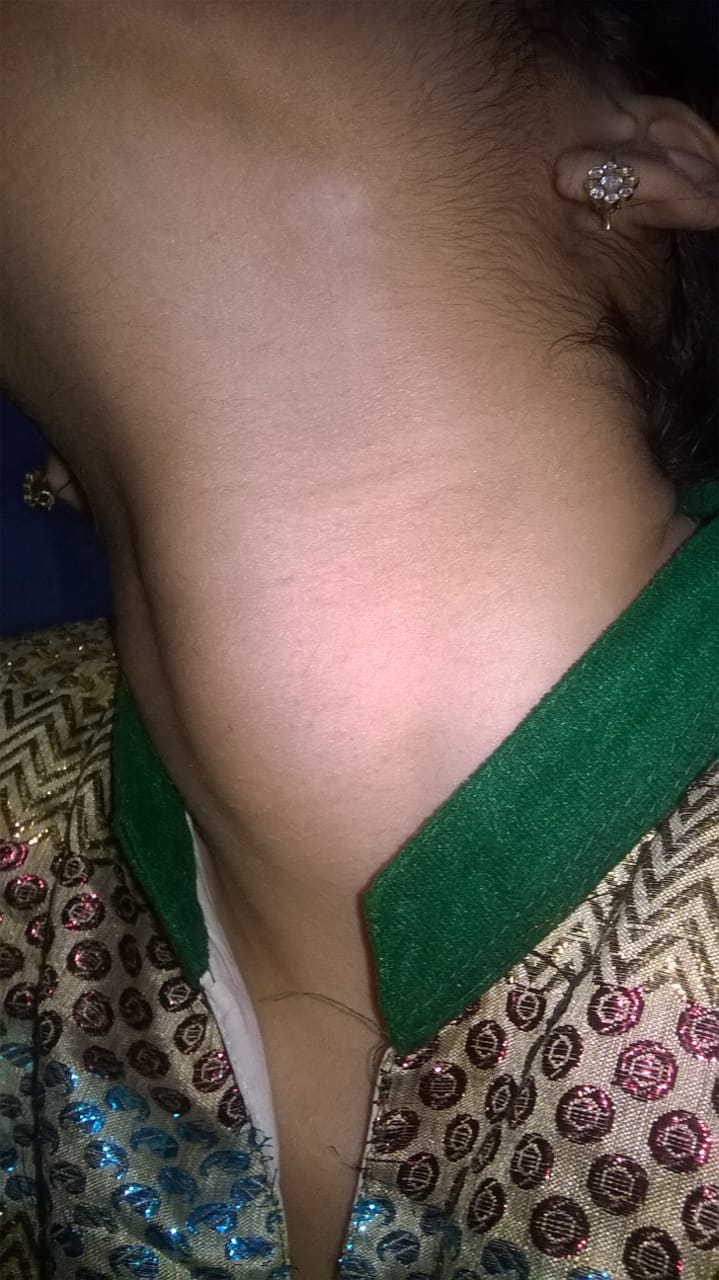
Vitiligo is believed to be an immune mediate disorder affecting skin.
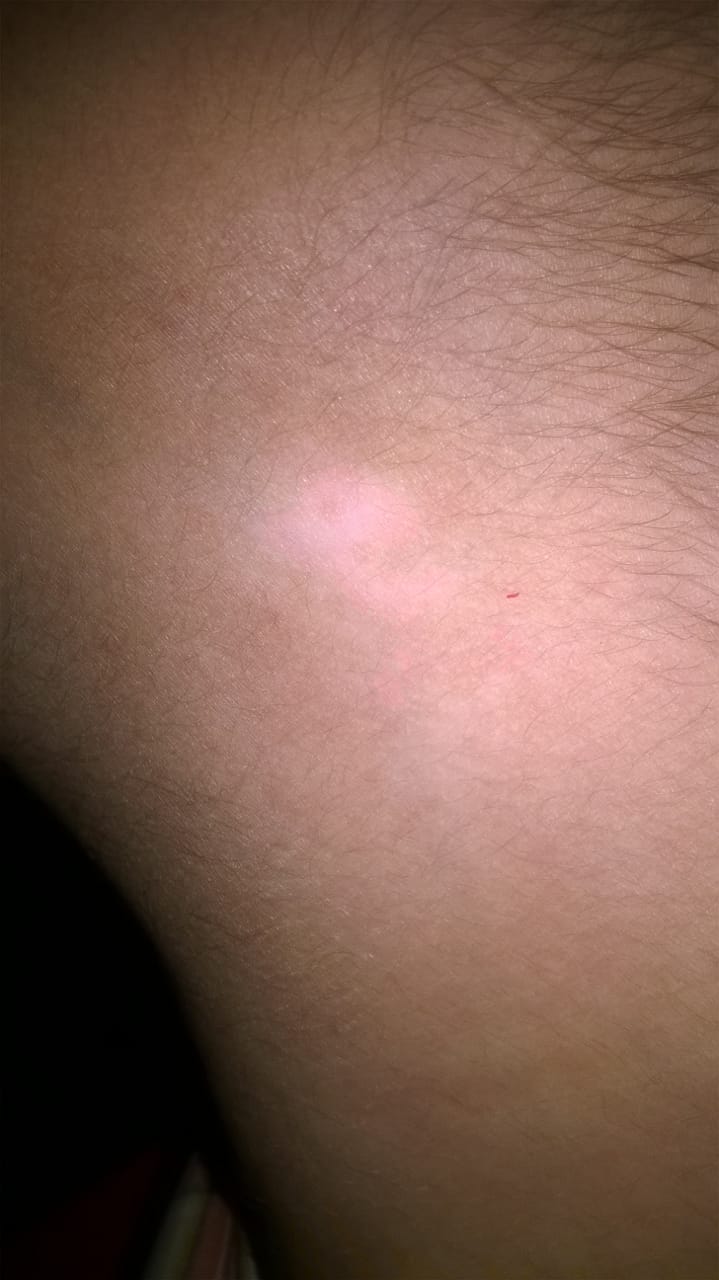
It is characterized by depigmented spots with sharp well defined margins bilateral in most of the cases , usually patches appears on exposed parts, extremities, body orifices, most common sites involved are hand, wrist, lips, face, feet, umbilicus, eye lids, nostrils mucosa of nose eye and mouth are also involved.
BEFORE TREATMENT: VITILIGO CASE Sept 2015 – At Dr SHAH HOMOEOPATHY- Dr DEEPAN P SHAH
DURING TREATMENT: VITILIGO CASE NOVEMBER 2016 – At Dr SHAH HOMOEOPATHY- Dr DEEPAN P SHAH
DURING TREATMENT: VITILIGO CASE JAN 2018 – At Dr SHAH HOMOEOPATHY- Dr DEEPAN P SHAH
CLOSE UP PIC OF RECOVERY DURING TREATMENT: VITILIGO CASE – At Dr SHAH HOMOEOPATHY- Dr DEEPAN P SHAH
PATHOGENESIS and GENETICS
Its cause is not known, but it’s believed to be multifactorial disease which is genetically predisposed and triggered by Environmental factors. It is frequently accompanied by other autoimmune conditions like Hashimoto’s thyroiditis, psoriasis, systemic lupus erythematoses, pernicious anaemia, alopecia areata etc.It is a non infectious condition. A strong hereditary association is noted.
Tyrosinase the enzyme of melanocyte expressed by TYR genewhich is not the component of immune system but catalyzes melanin synthesis and is a major autoantigen in generalised vitiligo. A genomewide dtudy have found around 36 loci associated with succeptibility towards generalised vitiligo, its usually due to defect in genes related to melanocytes or immune system , its doubted that there might be some autoimmune response towards melanocytes.
SYMPTOMS AND CLASSIFICATION
It can be classified into segmentaland nonsegmental types
In nonsegmental type the depigmentation appear somewhat symetrical and bilateral and usually grow with time and also appears in new areas with somewhat symetrical pattern it can start at any age and can grow to generalised or universalis where very few normal pigmented patches are left behind.
It is further categorised into
Vitiligo Universalis depigmented patches cover almost whole body with very few patches of normal pigmented patches are left behind , Micheal Jackson suffered from this type.
Generalised Vitiligo depigmented patches scattered throughout the body in somewhat symeterical fashion.
Focal Vitiligoone or few small patches in an area, commonly found in children.
Acrofacial vitiligo only fingers and periorificial areas involved
Mucosal Vitiligo only mucosal membranes involved
Segmental type usually affects segments of skin supplied by dorsal root from spinal cord. its usually nonsymetrical and unilateral, it is less frewuently associated with other autoimmune disorders as compared to segmental type, it usually is stable and static and does not grow much in size eith time.
DIAGNOSIS
When patches of affected skin are exposed to UV-A light it glows blue and the normal unaffected skin shows no reaction
Biopsy helps in confirmation of diagnosis
MEDICINES FOR VITILIGO IN HOMEOPATHY
BELOW MEDICINES ARE ONLY FOR QUICK REFERENCE AND THERAPUTIC HINTS.
ITS ALWAYS RECOMENDED TO TREAT SUCH AUTOIMMUNE CONDITIONS CONSTITUTIONALY, AFTER PROPER REPERTORISATION AND HOMEOPATHICALLY INDIVIDUALISED SIMILIMUM REMEDY SELECTION.
THE ABOVE MENTIONED CASE WAS TREATED WITH SINGLE SIMILIMUM DOSE FOLLOWED BY PLACEBO TILL DATE AND IT KEPT ON IMPROVING.
PSORALEA CORYLIFOLIA
Psoralea corylifolia used not only in homeopathy but also is an important plant in Ayurvedic system of medicone. The seeds have a variety of traditional medicinal uses. Psoralea corylifolia is used in Homoeopathy and other system of medicines.
Psoralea corylifolia mother tincture is used therapeutically for various kinds of disorders. Psoralea corylifolia is a vedy valuable remedy in case of Vitiligo. It has a poweful action on the skin as it causes dilatation of arterioles of body leading to pigment formation which diffuses into discolorized leucodermic patches. It contains enormous biological values and is been used to treat various skin diseases from a long time like vitiligo, psoriasis, eczema. Psoralea corylifolia consists main components psoralen and iso psoralen thus it has antibacterial and anti viral properties. Psoralea corylifolea were used thousands of years ago in India for repigmentation of skin in vitiligo patients.
AMMI VISNAGO
Ammi visnago is a natural substance used since a long time in herbal medicine. Ammi visnago is extracted from a plant in carrot family. Ammi visnago is a very beneficial remedy used in treatment of Vitiligo. Marked white patches are seen on the skin, it usually occurs when the melanocytes stop producing melanin. Usually the discoloration first shows on sun exposed areas such as hands, feet, arms, face, lips. Along with skin discoloration, there is permature greying of hair. Ammi visnago helps in repigmentation of vitiligo affected area.
IODIUM
Iodium is one of the indicated remedy in vitiligo. Usually presents with whitish discoloration of skin, whitish spots appear in patches. Melanocytes stop producing melanin, the pigment that gives color to skin, hair etc. Hence the involved patches become lighter. Iodium is usually suited to persons of scrofulous diathesis with dark black hair. Profound debility, great emaciation. Striking feature of iodium is eats ravenously yet emaciates.
ARS SULPH FLAVUM
ARS SULPH FLAVUM is one of the deep acting remedy which has very good results in case of vitiligo. The patient usually presents with discoloration of skin in patches that are pale white in colour. Ars sulph flavum is especially indicated when vitiligo is at the muco cutaneous junctions. Also indicated in other skin disorders such as eczema.
SULPHUR
Sulphur is a great general antipsoric remedy widely used for various kinds of skin diseases. It is often of great use in begining the treatment of any chronic diseases. Erruptions almost of every kind. Useful in case of vitiligo. Whitish discoloration of skin. Skin is usually dry, rough, wrinkled. Unhealthy skin. Every erruption presents with great itching, sometimes itching occurs even without any erruption. Burning is the most characteristic symptom of sulphur.
When solids and particulate metabolites or salts starts depositing at any level of urinary collecting system it forms renal stones or urolithiasis
An organic matrix of mucoprotien is present in all above types of stones which acts as an additional binding matrix and it makes up almost 2.5 % of weight in all stones.
Urolithiasis is more common in males than in females
Increased concentration in urine, of the constituents of stones is associated with stone formation.
COMPOSITION AND INCIDENCE OF DIFFERENT TYPES OF RENAL STONES
1) Calcium Oxalate/Phosphate Stonescomprises 75% of every stones.
Its observed that almost 50 % of cases of Calcium Stones that have idiopathic hypercalciuria and doesn’t have hypercalcemia.
10 % of cases calcium stone cases have both hypercalcemia and hypercalciurea
5% have Enteric(4.5%) or Primary (0.5%) hyperoxaluria
20% have hyperuricosuria
15-20% have unknown metabolic anomaly
2) Struvite Stones (Magnesium, Ammonia, Calcium, Phosphate) usually due to renal infections comprises off 10-15% of all stones.
3) Uric Acid Stones comprises 6% of all stobe cases 50% of which are associated with hyperuricosuria and/or hyperuricemia and 50% are of idiopathic origin.
4) Cystine Stone comprises only of 1-2% of all the cases
5) Other and unknown types of stonescomprises of upto 10% of all the cases
An organic matrix of mucoprotien is present in all above all types of stones which acts as an additional binding matrix and it makes up almost 2.5 % of weight of all stones.
Renal caliculus, while selecting homoeopathic remedy for Kidney stones it is important to make note of all accompanying symptoms, like type of pain , character of urine, and if there are gravels in urine then its colour shape size should be noted, also other miasmatic and constitutional background should be evaluated for proper similimum remedy selection.
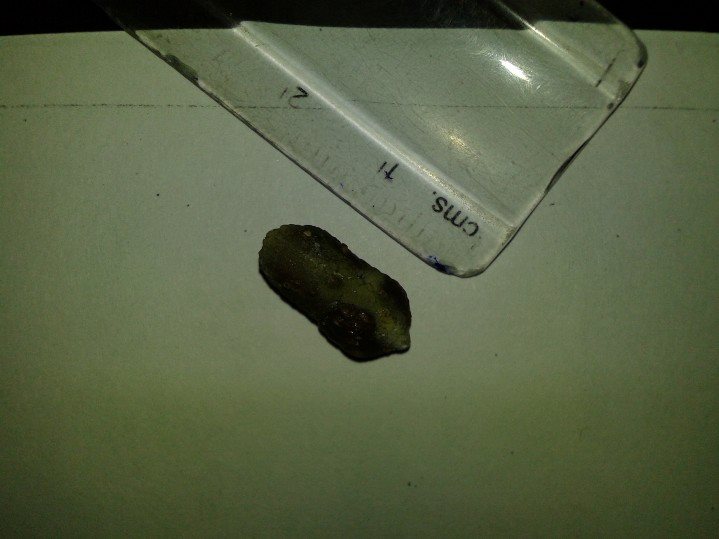
14mm Renal Caliculus removed nonsurgically at Dr SHAH’s Homoeopathy
14mm Renal Caliculus removed nonsurgically at Dr SHAH’s Homoeopathy
Risk factors
Increases Risk:
Dehydration, Low water intake, excess grapefruit or apple juice intake soft drinks containing phosphoric acid especially areated drinks.
Excess red meat consumption increases concerntration of certain sulfurous amino acids like cystiene and methionine which acidifies urine , decreases citrate excretion through urine and increases excretion of calcium and uric acid through urine thus increasing risk of renal stones.
Calcium suppliment tablets and VitaminD suppliment for long term may cause Calcium Stones
Studies show that low dietary calcium promotes calcium stones:- Unlike supplimental calcium , Natural dietary calcium actually protects you against renal stones. As it binds with ingested oxalate from food in gastro-intestinal tract to form calcium oxalate and thus reducing its absorption and inturn reducing oxalate concentration in urine. Oxalate is 15 times more potent in forming renal stones compared to increased levels of calcium in urine.
Sodium and fluoridated water increases urinary excretion of calcium thus increases risk of stone formation.
Low urinary excretion of citrate
Decreases Risk:
Unlike supplimental calcium , Natural dietary calcium actually protects you against renal stones. As it binds with ingested oxalate from food in gastro-intestinal tract to form calcium oxalate and thus reducing its absorption and inturn reducing oxalate concentration in urine. Oxalate is 15 times more potent in forming renal stones compared to increased levels of calcium in urine
Studies show that low dietary calcium promotes calcium stones.
Magnesium inhibits stone formation.
Patassium promotes urinary excretion of citrate and citrate inhibits crystallisation of calcium and thus reduces risk of urinary calcium stones
Commonly Used Homoeopathic Remedies For Renal Caliculus
BERBERRIES VULGARIS
Sensation of retention of urine and urge to pass it again soon after passing, patient is thirstless, bright red mealy sediments, bubbling sore sensation in renal region, pain in urinary bladder region, pain radiating from lumbar region to pelvis and down to lower limbs while passing urine, burning in urethra even when patient is not passing urine, feequent micturation, well indicated in patients with renal caliculus with gouty diathesis and elevated uric acid levels and urate crystals in urine. Works well in patients having glomerulonephritis along with Renal Caliculus.
HYDRANGEA ARBORESCENS
white amorphous salt in urine giving urine a turbid colour, white amorphous salt in urine deposits in form of gravel. Sharp pain in loins especially in left side with unquenchable thirst for large quantity water, unlike berberries vulgaris which has thirstlessness. Well indicated in patients with enlarged prostate and also having Renal caliculus.
CANTHERIS
In patients with bleeding due to renal stones, heamaturia and Nephritis, Intolerable constant urge to pass urine with paroxysmal acute cutting and burning from lumbar region to pelvis in front, urinary tract infection due to stone initially causing membranous scales giving appearance of bran in water when passed profuse urine and later on urine mixed with blood passes drop by drop jelly like shreddy urine , membranous scales giving appearance of bran in water, infection of urethra due to damage by renal stone causing irritation in urethra increasing sexual desire.
SARSAPARILLA
Scanty slimy flaky sandy and bloody urine, gravels in urine that passes in thin stream, this medicine should be thought of when sand-like gravels seen on daiper of children and they are cranky before and during passing urine, Kidney stones on right side.
PAREIRA BRAVA / CONDODENDRON TORMENTOSUM
great tenesmus while passing urine, constant urge to pass urine but has to strain much while passing has to bend down on his knees and press head on floor in front to pass urine causing pain to radiating till his thighs, Urine dribbles after micturating, pain in glans penis, renal stones in patient with gonorrhoeal urinary tract affections.
BORAX
Small red particles in urine and on daiper of child who cries while passing urine, hot smarting pain in urethra.
SOLIDAGO
Redish brown thick sediment gravels with offensive albuminuria , pain in renal angle radiating forward and downwards towards abdomen and pelvis.
SILICEA
its a wonderful homoeopathy know for its ability to expel foreign particle from body, for which it is also termed as surgeons knife, Red or Yellow sedimentation prostorrhoea due to tenesmus in patients with retention of urine due to renal caliculus
LYCOPODIUM CLAVATUM
Heavy Red Sand Particle in urine, pain in right hypochondrium and right lumbar region , renal stones in old men with slow feeble urine with stangury, tenesmus and retention of urine.
CALCAREA CARBONICA
Calcium oxalate crystals in urine, sour fetid smelling urine with dark brown colour and white sediments and haematuria.
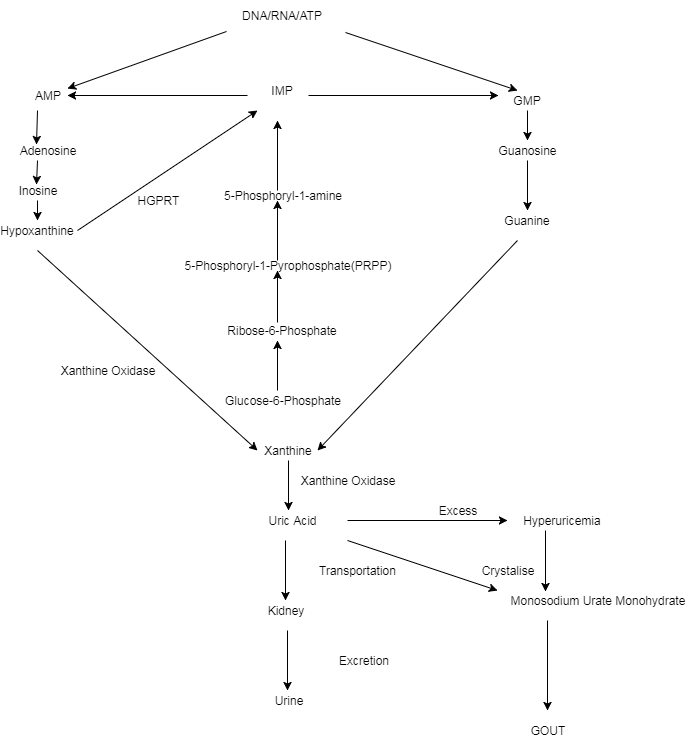
Gout is metabolically mediated type of arthritis strongly associated with genetics as a major cause, to which diet and lifestyle plays a contributory factor in its pathogenesis.It is primarily caused due to disorder of purine metabolism (purine is one of the major component of our gene it forms base pairs / nucleotides with pyrimidine to give structure to our gene; also purine is present in many food that we eat esp. certain sea food and many pulses).
Its when the final product of purine metabolism i.e uric acid, starts crystallizing and forming Monosodium Urate Monohydrate then it starts depositing in joint and tissues around joint its called gout and not mere hyperuricemia can be termed as gout.
PATHOGENESIS OF GOUT
GOUT PATHOGENESIS FLOW CHART
Purine De Novo Synthesis with Salvage Pathway and GOUT
Overproduction of uric acid may be due to one or more of following factors:-
Catabolism,
Loss of purine salvage mechanism,
Defective or sluggish transportation,
Under excretion of uric acid,
Reduced elimination of uric acid due competition of metabolites for elimination,
which results into hyperuricemia triggering Gout.
Although hyperuricemia has been found to trigger gout but many having maintaining uric acid within normal limits still develop goutand many having uric acid on higherside are still not developing gout. So genetics has major role in determining at what level of serum uric acid the patient may develop Gout.
When Uric acid crystalises into monosodium urate, it then starts precipitating in joints, tendons and surrounding tissues,in small clusters of deposits called tophi. Each tophus is collection of monosodium urate crystals surrounded by a protein wall. This protein wall prevents its interaction with surrounding cells and thus prevents inflamatory response. Occasionally this walled-off tophi breaks open the protein wall and so the urate crystals comes out naked in contact with surrounding cells, which may be due to medical, surgical metabolic, physical stress or sometimes even rise in serum uric acid levels may lead to breaking of this wall, which causes acute inflamation and sets in acute arthritis within few hours.
SYMPTOMS OF GOUT
Its usually observed that small joints of extremities which are not sufficiently insulated to tolerate cold and shocks and those that are in region where circulation is affected due to gravity dependence, like great toe and ankle , small joints of feet, hands and wrist are more prone compared to other joints. Although it can affect all the joints and can present itself with different signs and symptoms but it is classically known as Podagra for the one characteristic symptom it frequently presents in most of the patients, its the intense burning and sharp excruciating pain with mild redness and swelling especially on base of great toe (at first metatarso-phalangeal joint)starting suddenly and frequently at night waking patient up from sleep.
GENES ASSOCIATED WITH HYPERURICEAMIA AND GOUT
1) Absence of gene associated with breakdown of Uric Acid.
In humans unlike other carnivorous primates(meat eater in particular) the Uricase /urate oxidase, an enzyme which breaks down uric acid to 5hydroxyisourate then to allantoin, has became non functional during evolution phase and is present only as psuedogene/junk gene so, the humans have tendency towards probability of elevated levels of uric aciddue to lack of breakdown and accumulation which may trigger gout.
Uric Acid though may have beneficial effect as its a very powerful antioxidant and scavenger, helping body to protect itself from oxidative damage and thus prolonging life and reducing age-specific cancers, so hominids may have opted out the Uricase gene in selective evolution.
After we identified urate oxidase and its activity, we have artificially prepared protien Rasburicase. Rasburicase is now used to treat patient developing acute hyperuriceamia during chemotherapy. Also a PEGylated form of urate oxidase is in clinical development for treatment of chronic hyperuriceamia having “treatment failure gout”.
2) Defect in genes associated transportation and transfer of uric acid for elimination.
SLC2A9 The encoded protein by this gene plays a role in transportation of uric acid and also in development and survival of chondrocytes in the cartilage matrix. Any SNP (single neucleotide polymorphism) in this gene causes transcript variants encoding different isoforms, which increases the risk of development of Hyperuriceamia and also it may alter joint cartilage matrix both of these anomaly plays a major role in formation of gout.
SLC22A12 has 2 transcript variants encoding different isoforms; basically it encodes urate transporter and urate anion exchanger protein which regulates the level of urate in the blood; its an integral membrane protien primarily found in kidney; SNP of this gene causes altered reabsorption of Uric Acid by the kidney.
3) Genes associated with purine salvage mechanism.
PRPSAP1 and HPRT1are gene related to Purine salvage mechanism.
Phosphoribosyl Pyrophosphate Synthatase associated Protein 1(PRPSAP1).
PRPP (5-phosphoribosyl 1- pyrophosphate) is asubstrate used by HGPRT during purine salvage pathway.
Hypoxanthine Phosphoribosyl Transferase 1 (produce hypoxanthine-guanine phosphoribosyl transferase (HGRPT)which plays main role in generation of purine nucleotide through purine salvage pathway).
SNPor deletion of any of the above mentioned gene causes hyperuriceamia and also other severe conditions.
4)Certain Genetic Disease And Syndromes Presents Hyperuricemia And Gout As One Of The Symptom Like In :-
Familial Juvenile Hypouricemic Nephropathy (FJHN)associated with UMOD gene. UMOD gene produces Tamm horsfall protien, whose function is still not well understood but defect in this gene produce many autosomal renal disorders characterised by juvenile onset of hyperuricemia, gout and progressive renal failure.
Medullary Cystic Kidney disease (type I and II).
Lesch Nyham Syndrome is an X-linked Syndrome caused due to HPRT1 Gene deletion (details of HPRT1 have been mentioned elsewhere above in this page).
Physical trauma, Wasting Diseases ,Surgery are associated with increased uric acid levels.
In patients with recurrent acute episodes of arthritis especially of great toeaccompanying hyperuricemia is sufficient to establish the diagnosis. However an episode of acute arthritis in many instances may not accompany hyperuricemia, so arthroscentesisshould be done for synovial fluid analysis for visualising monosodium urate crystals or tophus is the only confirmatory test whether patient is hyperuricemic or not.
DIET AND LIFESTYLE ASSOCIATED TO GOUT AND HYPERURICEMIA
Food rich in purine especially red meat and sea foodis considered to be associated with hyperuricemia. Its found that moderate consumption of purine rich vegetarian diet is not associated with the condition. Also total protien has no impact untill not much of it is in form of purine.
Alcohol consumptionand Fructose sweetened food and drinks are strongly associated with it.
Metabolic syndrome, diabetes, cardiovascular disease, and aging process are also associated with this conditionand they tend to worsen each other.
Vitamin C, Coffee and switching to Dairy Products for protein requirement will also help.
Weight reduction and regular exercise helps reduce Uric acid.
Raised uric acid level is also associated with renal stones and urate nephropathy.
HOMOEOPATHIC REMEDIES FOR GOUT and HYPERURICEMIA(raised serum uric acid)
ARNICA MONTANA
Arnica is a traumatic remedy par excellence. Arnica is an useful remedy in chronic cases of gout. Old cases of gout rouse into a new soreness of joints with great sensitiveness. Arnica is an important remedy in injuries, bruises, shocks etc. Trauma in all its varieties mental or physical and their effects recent or remote are met with this remedy. If we observe a arnica patient in order to get the external manifestations of his state, he is constantly moving,turning and highly restless. The patient has sore lame bruised feeling, so sore that he can lie on one part only for a while and must keep changing position as the bed he lies on feels hard. Limbs ache as if beaten. Inflamation of joints.
ACTEA RACEMOSA
Actea racemosa is a very well indicated remedy in gouty and rheumatic diathesis. Swelling of joints with raised uric acid levels. Its muscular and crampy pains are primarily neurotic origin, occuring in nearly every part of the body. Pains of actea racemosa are like that of electric shock, comes suddenly and also its relieved suddenly. There is stiffness and pain in the tendo achillies. It has wide action on muscles nerves joints. Rheumatic aching pains in joints and muscles with stifness of joints. Causes depression of mind with low spirits and exhaustion along with oversensitiveness especially during pain.
ABROTANUM
Abrotanum is a very valuable remedy which is used more frequently. Indicated in gout and increased uric acid levels. Rheumatism and gout alternate with haemorrhoids. Abrotanum increases circulation and opens small arteries as a result the blood flow and local defense of joints and muscles is stimulated. Abrotanum relives gout pain.
ACONITE NAPELLUS
Aconite napellus is very well indicated in rheumatic and gouty conditions of joints. Those that come on as first attack. Not old rheumatic and gouty attacks but those that come on from exposure to cold. Rapidity of action of aconite determines its symptomatology. Presents with Symptoms are acute painful and violent pain in the joints. Aconite is indicated in acute onset of pain and swelling. Used in 1st stage of inflammatory condition with severe mental restlessness. Fear. Fright and anxiety.
BELLADONNA
Belladona is useful in inflamtory rheumatism and gout.Symptoms that suggest this remedy are sudden onset, swollen joints, red hot, throbbing pain with extreme sensitiveness. Complaints of belladona that is the pains and suffering come on suddenly run a regular course and subside suddenly. Sudden attack of cold worsens the complaints.
COLCHICUM AUTUMNALE
Colchicum is a primary remedy used for treatment of gout because of its effectiveness.most useful in chronic gout. Colchicum has marked action of the joints, indicated in case of gouty arthritis and increased uric acid levels. Helps in relieving the gouty paroxysms. Inflammation of great toe, gout in heel, cannot bear to be touched. Oedematous swelling and coldness of feet. Joints are red hot swollen. Pains are usually worse in evening and night.
LEDUM PALUSTURE
Ledum pal is mostly used in rheumatic and gouty diathesis. Remedy affects the fibrous tissues of joints especially small joints, ankles,heels.Used in cases where the gouty pains shoot through the foot, limbs and smaller joints. There is great swelling in the foot and ankle. Joints hot and swollen with with cracking in joints. Gouty nodosities. Ball of great toe is swollen. Soles are very painful can hardly step on them. Aggravation from warmth is so vreat that the patient can only get relief to his rheumatism by sitting with his feet in icy cold water.
NATRUM SULPHURICUM
Natrum sulph is used for symptoms associated with gout it may be acute or chronic. Swelling and burning of joints. Pain compels frequent change in position with stiffness of joints. Burning in sole with oedema of feet.
RHUS TOXICODENDRON
Rhus tox is one of the most frequently indicated remedy for rheumatic and gouty complaints. Rhus tox usually affects the fibrous tissue markedly joints, tendons, producing pain and stiffness. Rhus plays a good role in gouty complaints. Hot painful swelling of joints. Tearning pains in tendons, ligaments and fasciae. Affects the smaller joints, parts feel sore and bruised with stiffmess. All complaints worse from cold damp weather and motion in any ailment and relieved from warmth.
URTICA URENS
Urtica is useful in rheumatic and gouty diathesis. This remedy helps in elimination of uric acid from the body. The patient has tendency to uric acid and gout formation. The joint complaints are usually associated with hive like erruptions. Presents with pain in small joints. Worse from exposure to cold moist air, wet weather.
BENZOICUM ACIDUM
Benzoicum Acidim is a very Specific and Infallible remedy in cases of chronic and acute gout, usually given in lower potencies in frequent repetitions.
LARGE TOPHUS OF GOUT AT Dr SHAH’s Homoeopathy
LARGE TOPHUS OF GOUT 2 IMAGE CLICKED AT Dr SHAH’s HOMOEOPATHY by Dr DEEPAN P SHAHPODAGRA GOUT HYPERURICEMIA Podagra – Inflamation of 1st Metatarsophalangeal Joint (Joint of great toe to feet) in patient with Hyperuricemiam or elevated Uric Acid. Its a classical presentation of Gout. PODAGRA GOUT HYPERURICEMIA Podagra – Inflamation of 1st Metatarsophalangeal Joint (Joint of great toe to feet) in patient with Hyperuricemiam or elevated Uric Acid. Its a classical presentation of Gout.