An extraordinary possibility hidden in an ancient Sanskrit text
Modern particle physics tells us that matter is built from fundamental particles. Among the most fundamental constituents known today are six types, or “flavours,” of quarks:
Up, Down, Charm, Strange, Top and Bottom.
But an intriguing question arises from an ancient Indian text.
Did Manusmriti, written many centuries before modern experimental science, describe a six-fold set of subtle constituents underlying the manifested world?
The relevant passage occurs in Manusmriti 1.14–1.18, and the key verses deserve a closer examination.
The Crucial Statement: “Six Subtle Constituents”
Manusmriti 1.16 states:
तेषां त्ववयवान् सूक्ष्मान् षण्णामप्यमितौजसाम् ।
संनिवेश्यात्ममात्रासु सर्वभूतानि निर्ममे ॥
The important words are:
- avayavān — components or constituents
- sūkṣmān — subtle, minute
- ṣaṇṇām — of six
The verse therefore speaks of the subtle constituents of six and describes them as being involved in the formation of all beings.
Verse 1.17 continues:
यन्मूर्त्यवयवाः सूक्ष्मास्तानीमान्याश्रयन्ति षट् ।
तस्माच्छरीरमित्याहुस्तस्य मूर्तिं मनीषिणः ॥
Again we encounter the words:
- sūkṣma — subtle/minute
- avayava — constituent/component
- ṣaṭ — six
The passage therefore presents a six-fold set of subtle constituents associated with manifested form.
That is the first remarkable point.
And Modern Physics Has Exactly Six Quarks
Modern physics identifies six quark flavours:
| Generation | Quarks |
|---|---|
| First | Up — Down |
| Second | Charm — Strange |
| Third | Top — Bottom |
Thus:
3 generations × 2 quarks = 6 quarks.
These six are not merely six arbitrary particles. They form one of the fundamental families of the Standard Model of particle physics.
The striking question is therefore:
Why does an ancient Indian cosmological text speak of six subtle constituents underlying manifested reality, while modern physics independently identifies six fundamental quark flavours?
Is this merely coincidence?
Or could both descriptions be pointing toward a deeper structure of nature?
What Exactly Did the Ancient Text Mean?
This is where the discussion becomes fascinating.
Traditional Sanskrit commentators, particularly Medhātithi, interpret the six mentioned in this passage within the framework of ancient Indian philosophy. They do not describe them as modern physical particles.
The ancient framework speaks of subtle principles underlying the observable world.
These are not described using concepts such as:
- mass,
- electric charge,
- spin,
- quantum number,
- colour charge, or
- particle flavour.
Therefore, it would be incorrect to claim that Manusmriti literally gives the modern names of the six quarks.
But that does not necessarily end the comparison.
The deeper question is whether the ancient description and the modern description might represent two different conceptual languages attempting to describe fundamental constituents underlying observable reality.
The Remarkable Word: Sūkṣma
One of the most important words in the passage is sūkṣma.
It can mean:
subtle, minute, extremely fine, imperceptible or beyond ordinary sensory perception.
This is significant because the ancient author is not simply describing ordinary visible objects.
The text is discussing constituents that are subtle and not directly available to ordinary perception.
Modern elementary particles are similarly far removed from everyday sensory experience.
We do not see an individual quark with our eyes.
Its existence is established through sophisticated experiments and the measurable effects it produces.
The ancient and modern approaches are therefore strikingly different in methodology—but similar in one fundamental ambition:
To understand the visible world in terms of entities or principles that lie beneath ordinary perception.
From Fundamental Constituents to the Visible World
The ancient passage presents a process in which subtle constituents participate in the formation of manifested beings.
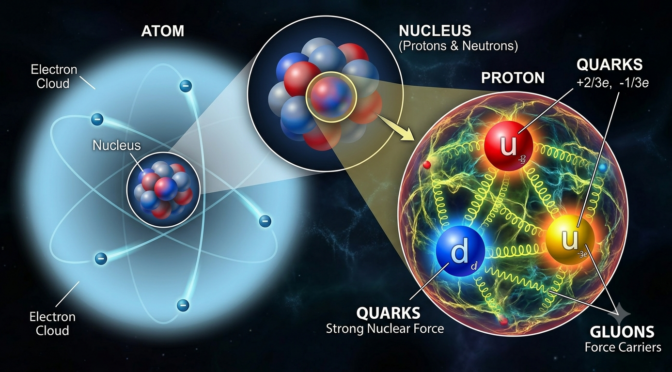
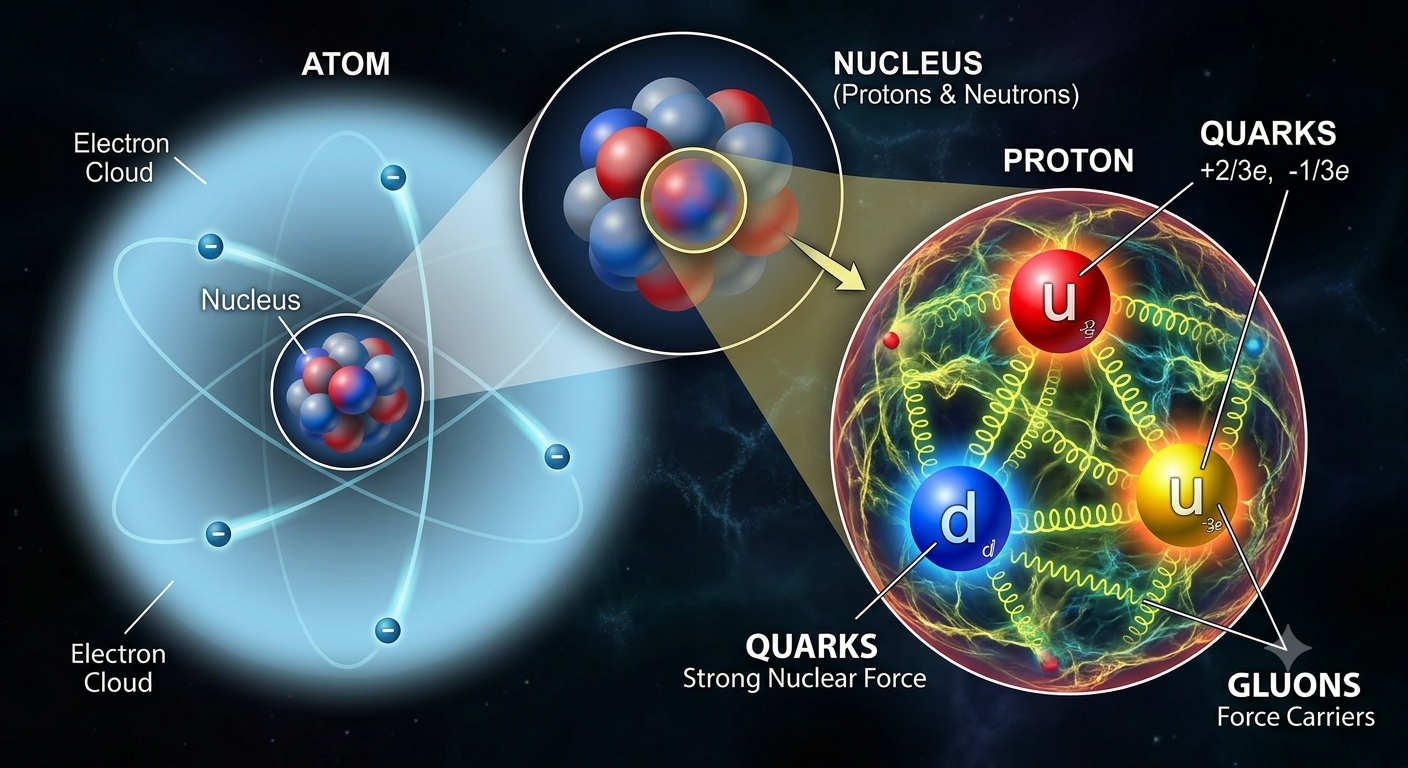
Modern physics similarly describes matter through successive levels of structure.
A simplified modern picture is:
Quarks → Protons/Neutrons → Atomic nuclei → Atoms → Molecules → Ordinary matter
The ancient cosmological framework also attempts to move from subtle underlying principles toward increasingly manifested forms.
In both cases, therefore, we encounter a powerful conceptual idea:
The enormous diversity of the visible world may arise from a much smaller number of fundamental constituents.
This is perhaps the most important similarity between the two approaches.
Six Is Not the Only Interesting Feature
The correspondence becomes even more intriguing because the modern six quarks are not simply an unstructured list.
They occur in three generations:
Up / Down
Charm / Strange
Top / Bottom
The Standard Model therefore organizes fundamental matter into a highly structured six-member family.
The ancient Indian philosophical traditions likewise frequently attempted to organize the diversity of reality into systematic categories and successive levels.
This does not prove that the ancient categories were quarks.
But it raises an important historical and philosophical question:
Could the ancient classification represent an abstract attempt to understand fundamental structure rather than a literal description of familiar physical substances?
The Strongest Possible Interpretation
If we want to make the strongest case for the ancient insight, we should not claim:
“Manusmriti named the six quarks.”
It clearly did not.
Nor should we arbitrarily assign one ancient term to Up, another to Down, another to Charm, and so on.
There is no textual evidence for such a one-to-one mapping.
The more interesting argument is considerably broader:
Manusmriti describes six extremely subtle constituents underlying manifested existence, while modern physics identifies six fundamental quark flavours underlying the structure of matter.
The two descriptions come from completely different civilizations, eras and intellectual methodologies.
Yet both present reality as arising from a small number of fundamental constituents.
That parallel deserves examination.
Coincidence—or Ancient Insight?
There are several possibilities.
Possibility 1: Coincidence
The number six appears independently in the two systems.
The ancient concepts and quarks have different meanings, and the similarity ends there.
Possibility 2: A Conceptual Parallel
Ancient thinkers and modern physicists independently arrived at a similar philosophical idea:
Complex observable reality can emerge from a small number of fundamental constituents.
Possibility 3: An Ancient Description of Deeper Physical Reality
The most extraordinary possibility is that the ancient description somehow encoded an insight into fundamental reality that modern science has only much later begun to uncover experimentally.
If that were eventually demonstrated, it would represent a remarkable example of ancient scientific insight.
At present, however, this remains a hypothesis.
Why the Idea Should Not Simply Be Dismissed
There are two equally problematic extremes.
One extreme is to say:
“The ancient text contains the six quarks exactly.”
That is not supported by the Sanskrit text.
The opposite extreme is to say:
“The ancient text cannot possibly have any relationship to modern science.”
That also cannot be established merely by pointing out that the terminology is different.
The intellectually interesting position lies between the two.
The ancient text should be examined on its own terms, and its concepts should then be compared carefully with modern scientific concepts.
Only after such a comparison can we determine whether the similarity is superficial—or whether something deeper is present.
The Question That Remains
The real question is therefore not:
“Did Manusmriti use the word quark?”
It obviously did not.
The real question is:
Why does Manusmriti describe six subtle constituents as underlying manifested reality, and is there any deeper correspondence between this six-fold structure and the six fundamental quark flavours discovered by modern physics?
That question is testable only if we go beyond numerical coincidence.
We would need to examine:
- the precise Sanskrit terminology,
- the chronology of the relevant Indian philosophical traditions,
- the relationship between Manusmriti and Sāṃkhya thought,
- the characteristics attributed to the ancient constituents,
- the structure of the ancient cosmological model, and
- the experimentally established properties of the six quark flavours.
If a correspondence could be demonstrated that goes substantially beyond the number six, the implications would be extraordinary.
Ancient Intuition or Coincidence?
Thousands of years ago, Indian philosophers were asking questions about the hidden structure of reality.
Modern physics asks the same fundamental question using mathematics, experimentation and particle accelerators.
The languages are completely different.
The methodologies are completely different.
Yet both approaches seek to move beneath the visible world and identify the fundamental constituents from which greater complexity emerges.
And in Manusmriti 1.16–1.17, we encounter something particularly striking:
Six — subtle — constituents — underlying manifested reality.
Modern physics gives us:
Six — quark flavours — fundamental constituents — underlying the structure of matter.
Is this simply a remarkable coincidence?
Is it an example of two civilizations independently arriving at a similar conceptual insight?
Or did the ancient description preserve an intuition about the fundamental structure of nature that modern science is only now beginning to understand?
We do not yet have enough evidence to answer that question conclusively.
But perhaps that is precisely why the question is worth asking.
Ancient wisdom should not be blindly declared modern science—but neither should potentially profound parallels be dismissed without investigation.