Did Manusmriti Describe the Six Quarks Thousands of Years Ago?
An intriguing possibility hidden in Manusmriti 1.14–1.18
Modern physics tells us that ordinary matter is ultimately built from fundamental particles. Among these are the six flavours of quarks:
Up, Down, Charm, Strange, Top and Bottom.
The remarkable question is whether an ancient Indian text, written long before modern experimental science, may have described a comparable six-fold set of fundamental constituents.
The relevant passage occurs in Manusmriti 1.14–1.18, where the text speaks of extremely subtle constituents and explicitly uses the word ṣaṭ — six.
The key verse is Manusmriti 1.17:
यन्मूर्त्यवयवाः सूक्ष्मास्तानीमान्याश्रयन्ति षट् ।
तस्माच्छरीरमित्याहुस्तस्य मूर्तिं मनीषिणः ॥
The crucial words are:
sūkṣmāḥ — subtle/minute
avayavāḥ — components/constituents
ṣaṭ — six
The verse therefore describes six subtle constituents associated with manifested form or the body.
That numerical correspondence is striking.
The six ancient constituents
The traditional interpretation associated with Medhātithi identifies these six subtle constituents as the five tanmātras together with ahaṃkāra:
- Śabda — sound
- Sparśa — touch
- Rūpa — form/appearance
- Rasa — taste
- Gandha — smell
- Ahaṃkāra — self-identification/ego principle
The important point is not merely that there are six.
The text describes them as subtle constituents from which manifested existence is constructed.
This immediately invites comparison with modern physics.
Six ancient constituents — six modern quarks
Modern particle physics identifies six quark flavours:
| Ancient description | Modern physics |
|---|---|
| 1. Śabda | Up |
| 2. Sparśa | Down |
| 3. Rūpa | Charm |
| 4. Rasa | Strange |
| 5. Gandha | Top |
| 6. Ahaṃkāra | Bottom |
Of course, Manusmriti does not give the modern English names.
The argument is instead that both systems independently arrive at a six-fold set of fundamental constituents underlying manifested reality.
The question then becomes:
Is this merely coincidence, or could the ancient description represent an early conceptual recognition of fundamental building blocks of nature?
The deeper similarity
The comparison becomes more intriguing when we look beyond the number six.
Modern physics works from the principle that apparently complex matter is produced from a much smaller number of fundamental constituents.
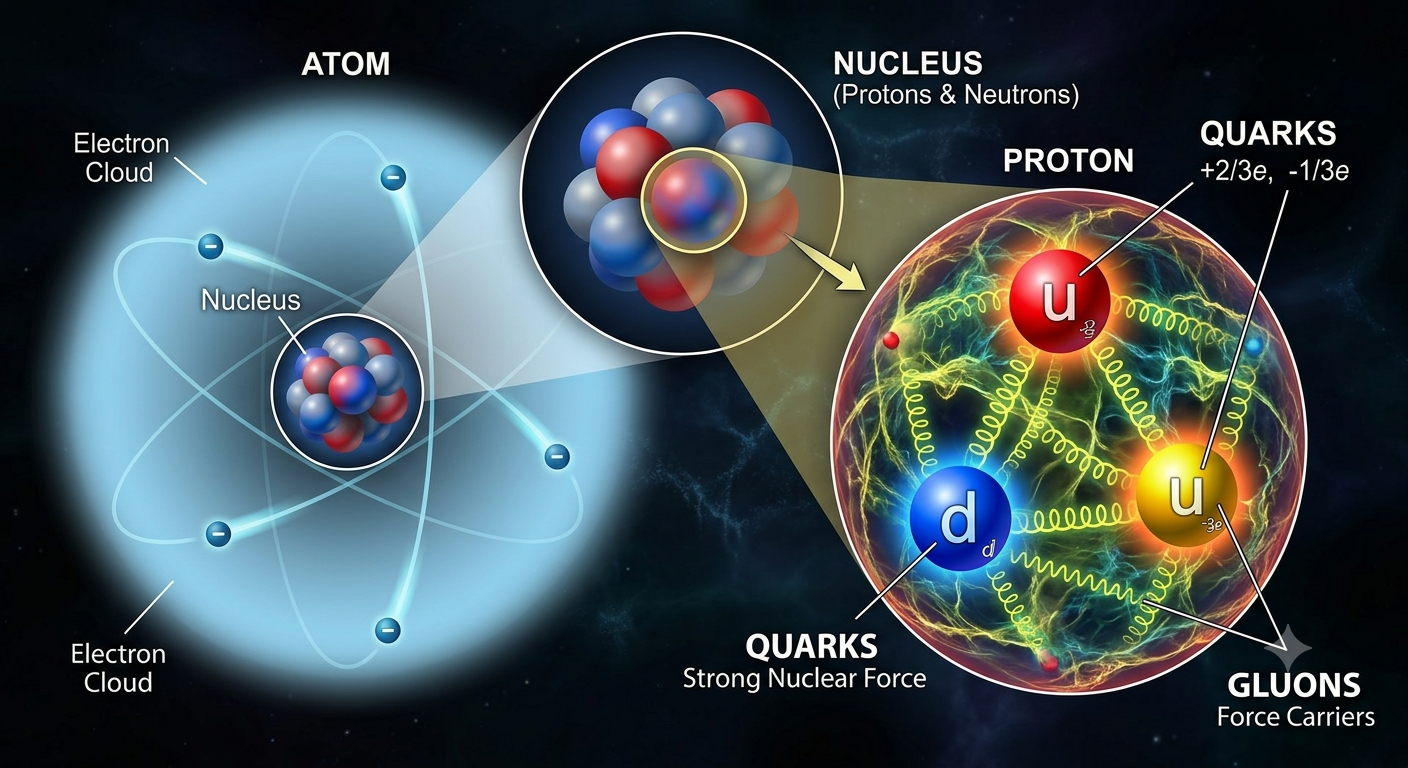
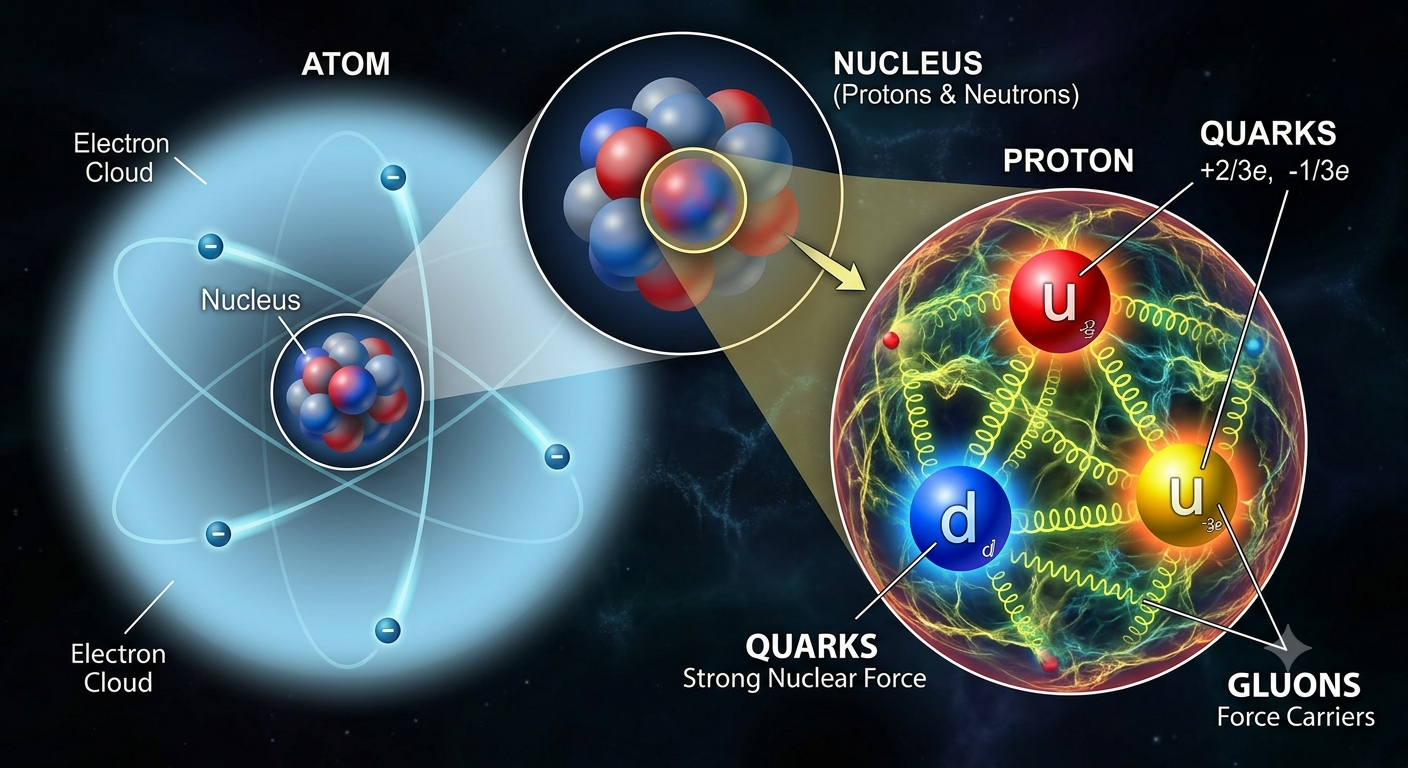
A proton, for example, is not regarded as an indivisible object. Its structure ultimately involves quarks and gluons.
Ancient Indian philosophical systems similarly sought to explain the enormous diversity of the visible world through a small number of subtle underlying principles.
The progression can be represented schematically:
Subtle constituents → combinations → manifested forms
Modern physics:
Quarks + gluons → protons/neutrons → atoms → molecules → matter
Ancient Indian cosmology:
Subtle principles → elements → bodies → manifested beings
The conceptual architecture is remarkably similar.
Why the word “sūkṣma” matters
One of the most fascinating words in the passage is sūkṣma.
It means subtle, minute, imperceptible or extremely fine.
The ancient authors were therefore not talking simply about visible objects.
They were attempting to describe entities beneath ordinary sensory perception.
That is precisely the conceptual territory occupied by modern particle physics.
Quarks cannot be seen with the naked eye. Their existence is inferred through experiments and their effects on observable matter.
Likewise, the ancient philosophical systems reasoned from the visible world toward invisible constituents.
This does not prove that the authors possessed modern particle accelerators or modern mathematical physics.
But it does suggest that the ancient Indian intellectual tradition was asking a surprisingly similar fundamental question:
What are the ultimate constituents underlying the world we experience?
Three generations — another remarkable parallel?
Modern physics does not merely have six quarks.
The six occur in three generations:
First generation
Up — Down
Second generation
Charm — Strange
Third generation
Top — Bottom
Thus the six are organised as:
2 × 3 = 6
Ancient Indian thought also frequently organised reality into hierarchical or successive levels rather than treating all constituents as unrelated objects.
This does not establish a direct correspondence between the three quark generations and any particular ancient triad.
But it raises an intriguing possibility:
Perhaps ancient descriptions of nature were not intended merely as lists of physical substances. They may have represented an attempt to identify fundamental categories beneath observable reality.
The strongest argument
The strongest argument is therefore not:
“Manusmriti gives the names Up, Down, Charm, Strange, Top and Bottom.”
It obviously does not.
The stronger and more intellectually defensible argument is:
Manusmriti describes six subtle constituents underlying manifested existence, while modern physics independently identifies six fundamental quark flavours underlying the structure of matter.
The two systems emerge from completely different intellectual traditions, yet both arrive at a six-fold fundamental structure.
That deserves investigation.
Could the ancient terminology encode physical properties?
This is where the hypothesis becomes more speculative.
The five tanmātras are traditionally associated with:
sound → touch → form → taste → smell
These are progressively associated with increasingly complex sensory qualities.
Modern physics, on the other hand, classifies quarks according to measurable properties such as:
- electric charge
- mass
- colour charge
- spin
- flavour
- interactions
Could the ancient sensory categories represent an abstract classification of physical properties rather than literal sensory objects?
If so, perhaps the ancient terminology should not be translated too literally.
“Sound,” “touch,” “form,” “taste” and “smell” might be interpreted as different modes through which underlying reality manifests itself to consciousness.
Under such an interpretation, the six constituents would not necessarily be six ordinary physical substances.
They would be six fundamental modes or principles underlying manifestation.
That would make comparison with modern fundamental particles conceptually more interesting.
But there is a major obstacle
There is one fact that cannot honestly be ignored.
The six ancient constituents are not scientifically identical to the six quarks on the evidence currently available.
A quark has experimentally measurable properties.
A tanmātra does not have a measured mass, electric charge or quantum number.
Similarly, ahaṃkāra, literally the “I-making” principle, clearly has a philosophical meaning that does not correspond straightforwardly to a particle.
Therefore, the claim cannot presently be demonstrated in the same way that the existence of quarks can be demonstrated experimentally.
The proposed correspondence is therefore a hypothesis, not an established scientific conclusion.
Yet dismissing the comparison entirely may also be premature
It would be equally simplistic to say:
“The concepts are ancient, therefore they have nothing to do with science.”
Ancient philosophical traditions often attempted to understand reality using conceptual frameworks radically different from modern mathematics.
The fact that an ancient system does not use the language of modern physics does not automatically make every comparison meaningless.
The real question is whether there is a sufficiently deep structural correspondence to justify further study.
And here the six-fold structure is undeniably interesting.
Coincidence or ancient insight?
There are three possible explanations.
1. Coincidence
The number six occurs independently in both systems.
The ancient categories and modern quarks have fundamentally different meanings, and the resemblance is accidental.
2. Philosophical analogy
Both systems independently recognised that enormous complexity could arise from a relatively small number of underlying constituents.
The similarity is conceptual rather than physical.
3. An ancient description of fundamental reality
The most ambitious possibility is that the ancient thinkers had somehow identified aspects of fundamental reality that modern science has only recently begun describing experimentally.
If this were true, the six constituents described in Manusmriti could represent an extraordinarily early conceptual anticipation of the six-fold structure later discovered in particle physics.
At present, however, the third proposition remains unproven.
The real scientific question
Instead of simply asking:
“Did ancient India discover quarks?”
a more productive question would be:
“Why did an ancient Indian philosophical tradition describe reality in terms of six extremely subtle constituents, and is there any mathematically or physically testable correspondence between those constituents and the six flavours of quarks?”
That question can actually be investigated.
Researchers could compare:
- the Sanskrit terminology,
- Manusmriti’s cosmological sequence,
- Sāṃkhya and Vaiśeṣika theories,
- the chronology of these traditions,
- the physical characteristics assigned to the ancient categories,
- and the quantum properties of the six quark flavours.
If a genuine correspondence could be demonstrated beyond numerical coincidence, it would be extraordinarily significant.
Conclusion
Manusmriti 1.14–1.18 contains a remarkable passage describing six subtle constituents associated with the formation of manifested reality.
Modern particle physics independently identifies six quark flavours as fundamental constituents of matter.
The parallel is striking:
Ancient India:
Six subtle constituents → manifested reality
Modern physics:
Six quark flavours → composite matter
This does not yet prove that Manusmriti’s six constituents are the six quarks.
But neither should the numerical and structural parallel be dismissed without examination.
Perhaps it is coincidence.
Perhaps it is a philosophical parallel.
Or perhaps ancient thinkers were expressing, in an entirely different intellectual language, an insight about the structure of reality that modern science is only now describing mathematically.
The evidence available today does not allow us to declare the two systems identical.
But it is certainly enough to justify asking the question.
If an ancient text really did speak of six subtle fundamental constituents long before modern particle physics identified six quark flavours, the right response is neither blind belief nor immediate dismissal—but investigation.